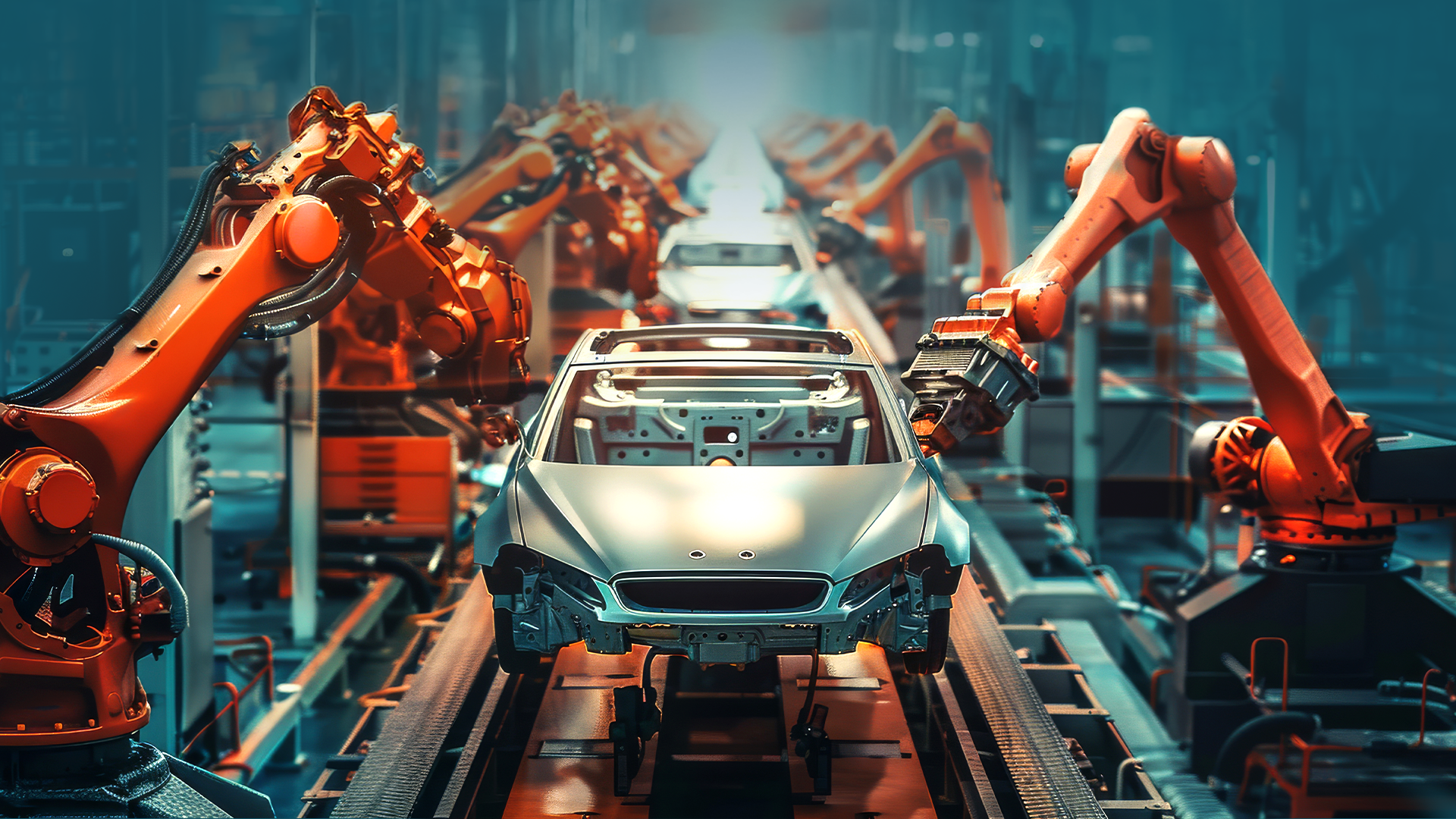
Global automotive manufacturing is undergoing a structural reset. Slowing demand in mature markets, rising production costs, supply chain disruptions, and accelerating regulatory pressures around emissions are compelling original equipment manufacturers (OEMs) to rethink where and how they manufacture vehicles. In this shifting landscape, India has emerged as one of the few large markets offering both sustained demand growth and scalable manufacturing depth.
India is already the world's third-largest automobile market by volume and the fourth-largest vehicle producer globally, with production rising from just 2 million[1] units in the early 1990s to nearly 33 million vehicles in CY 2025.[2] India uniquely pairs a massive, increasingly wealthy, and urbanizing population with a remarkably low car ownership rate of just 27.5 vehicles per 1,000 people.[3] This combination of scale and untapped market depth creates a massive runway for long-term growth in the automotive sector.
A report by Moody's notes that India's expanding workforce demographics and rising consumer spending are central to its long-term attractiveness for global auto manufacturers, even as demand stagnates in several developed markets.[4] This demand resilience is complemented by India's role as an export base, supplying vehicles and components to Africa, the Middle East, Latin America, and parts of Europe.
As a result, India is no longer viewed only as a sales destination. For global auto majors, it is increasingly positioned as a strategic manufacturing hub, serving domestic demand, supporting exports, and anchoring future investments in electric and advanced automotive technologies.
Table of contents:
- How India appeals to global auto giants
- The legacy play: How global OEMs built scale in India
- Riding on the next wave: EV manufacturing and new-age automotive investments
- Three decades of automotive manufacturing evolution
- Conclusion: From market of the future to the factory of the world
How India appeals to global auto giants
India's appeal as a manufacturing base for automobile companies rests on a convergence of scale, cost competitiveness, policy support, and ecosystem maturity. Together, these factors have reshaped the country's position within global automotive value chains.
With over 25 million vehicles sold in this fiscal year, till December, huge local demand remains the primary engine driving its role in the global auto industry.[5] India is already the world's 2nd largest manufacturer of two-wheelers and largest three-wheelers, and among the top five producers of passenger and commercial vehicles.[6]
At the same time, India offers structural cost advantages. Manufacturing costs are estimated to be 10–25% lower than in Europe and Latin America, supported by competitive labour costs and deepening localisation of components.[7]
While challenges remain, particularly in high-precision components, India's supplier ecosystem has matured significantly, with domestic OEM supply accounting for over half of auto component revenues.[8]
Policy stability has reinforced these fundamentals. The allowance of 100% FDI under the automatic route, combined with targeted incentive programmes such as the Production Linked Incentive (PLI) scheme for automobiles and advanced chemistry cell batteries, has lowered entry barriers and encouraged long-term capacity creation.[9] Between January 2000 and September 2025, the automobile sector attracted over $39 billion in FDI, among the highest across manufacturing sectors.[10]
At the same time, India's growing role as an engineering and R&D hub is equally important as it accounts for nearly 40% of global automotive engineering and R&D spend.[11] This enables global OEMs to localize products for cost-sensitive markets while maintaining global quality and compliance standards.
The legacy play: How global OEMs built scale in India
The foundation of India's automotive manufacturing story was laid by global OEMs that committed early and scaled steadily over decades. Companies such as Maruti Suzuki, Hyundai Motor India, and Toyota Kirloskar Motor transformed India from a protected market into a globally competitive production base.
Following the de-licensing of the sector and the introduction of 100% FDI in 1991, vehicle production accelerated sharply. Maruti Suzuki established India as a global hub for compact cars, exporting vehicles to over 100 countries. Hyundai developed India as its largest manufacturing base outside South Korea, with Indian plants supplying small cars and SUVs to multiple export markets. Toyota steadily expanded its footprint through localisation and supplier development, reinforcing India's position in both domestic and export-oriented manufacturing.[12]
This legacy manufacturing model focused on scale, localisation, and cost efficiency. Over time, localisation levels increased significantly across powertrains, body structures, and electronics. By FY25, India exported 5.3 million units' vehicles including Passenger vehicles, Two-Wheelers, Commercial vehicles and auto components worth $23 billion.[13]
Crucially, India also served as a hedge against volatility elsewhere. Over time, as global OEMs faced rising costs and regulatory pressures in Europe and North America, plants in India provided production flexibility and volume stability, particularly for internal combustion engine (ICE) vehicles, which continue to see strong domestic and export demand.
Riding on the next wave: EV manufacturing and new-age automotive investments
While legacy OEMs built India's manufacturing base around ICE vehicles, the next phase of expansion is being driven by electric mobility and advanced automotive technologies.
India's EV market remains in its early stages, with penetration of around 6–8%, but growth has accelerated sharply. In 2025, 8% of all new registered vehicles in India were EVs, recording sales of 23 lakh units.[14]
Global OEMs are responding by expanding EV manufacturing, battery assembly, and localisation of power electronics. Programmes such as the PLI scheme for Advanced Automotive Technologies and the PLI scheme for Advanced Chemistry Cell batteries, with a combined outlay exceeding ₹44,000 crore, are incentivising investments in EV platforms, hydrogen fuel-cell vehicles, and domestic battery manufacturing.[15]
Furthermore, the PM E-DRIVE scheme (2024–26) supports demand by targeting large-scale procurement of electric two-wheelers, three-wheelers, and buses, alongside nationwide expansion of charging infrastructure.[16] These measures are gradually addressing ecosystem gaps that have constrained EV profitability in the near term.
India's EV strategy focuses on selective localisation, cost reduction, and phased adoption, enabling manufacturers to balance investments in ICE and EVs as the domestic ecosystem matures.
Three decades of automotive manufacturing evolution
India's automotive manufacturing journey reflects a steady progression from assembly-led growth to value-chain integration. In the early 1990s, production was limited and import-dependent. By the 2000s, India had developed strong capabilities in vehicle assembly and in low- to mid-value components. Today, it stands at an inflection point.
The auto component sector illustrates this evolution clearly. With a turnover of Rs 6.73 lakh crore ($80.2 billion) in FY25 and exports of $22.9 billion, the sector has grown at an 8.6% CAGR since FY16.[17] Yet India still accounts for only 3 per cent of globally traded auto components, particularly underperforming in high-precision systems such as engines and transmissions.[18]
Recognising this gap, policy focus has shifted towards global value chain (GVC) integration, with targeted support for R&D, skills development, cluster development, and international collaboration. The objective is to raise India's share of global component trade to 8% by 2030, while generating a $25 billion trade surplus and up to 2.5 million new jobs.[19]
This retrospective underscores how India's manufacturing ecosystem can absorb technology, scale production, and improve quality over time, a critical prerequisite for next-generation automotive manufacturing.
Conclusion: From market of the future to the factory of the world
For global automotive majors, India's importance extends well beyond near-term cost advantages. It is increasingly a strategic hedge against geopolitical risk, supply-chain concentration, and demand stagnation in mature markets. As global OEMs rebalance their manufacturing footprints, India offers a rare combination of demand growth, production scalability, and policy stability.
Indian automobile sales are projected to grow at a 3.5% CAGR, outpacing other Asian markets and reaching over 5 million units annually by the end of the decade.[20] This growth trajectory, underpinned by low vehicle penetration and rising household incomes, is reinforced by India's expanding role as an export-oriented manufacturing base and sustained policy support for electric and advanced automotive technologies. Together, these factors create a strong alignment between short-term volume resilience and long-term strategic relevance.
Challenges remain, particularly in logistics costs, infrastructure gaps, and limited depth in high-precision component manufacturing. However, continued reforms, infrastructure investments, and deeper collaboration between OEMs and domestic suppliers are progressively narrowing these gaps, strengthening India's position within global automotive value chains.
As the global automotive industry transitions towards cleaner, smarter, and more connected mobility, India is well placed to play a central role, first as a large-scale manufacturing hub for conventional vehicles and increasingly as a base for electric and next-generation automotive platforms. For investors and OEMs alike, India is no longer merely the market of the future. It is rapidly becoming one of the world's most important automotive manufacturing platforms.
This blog is written by Anurag Taneja