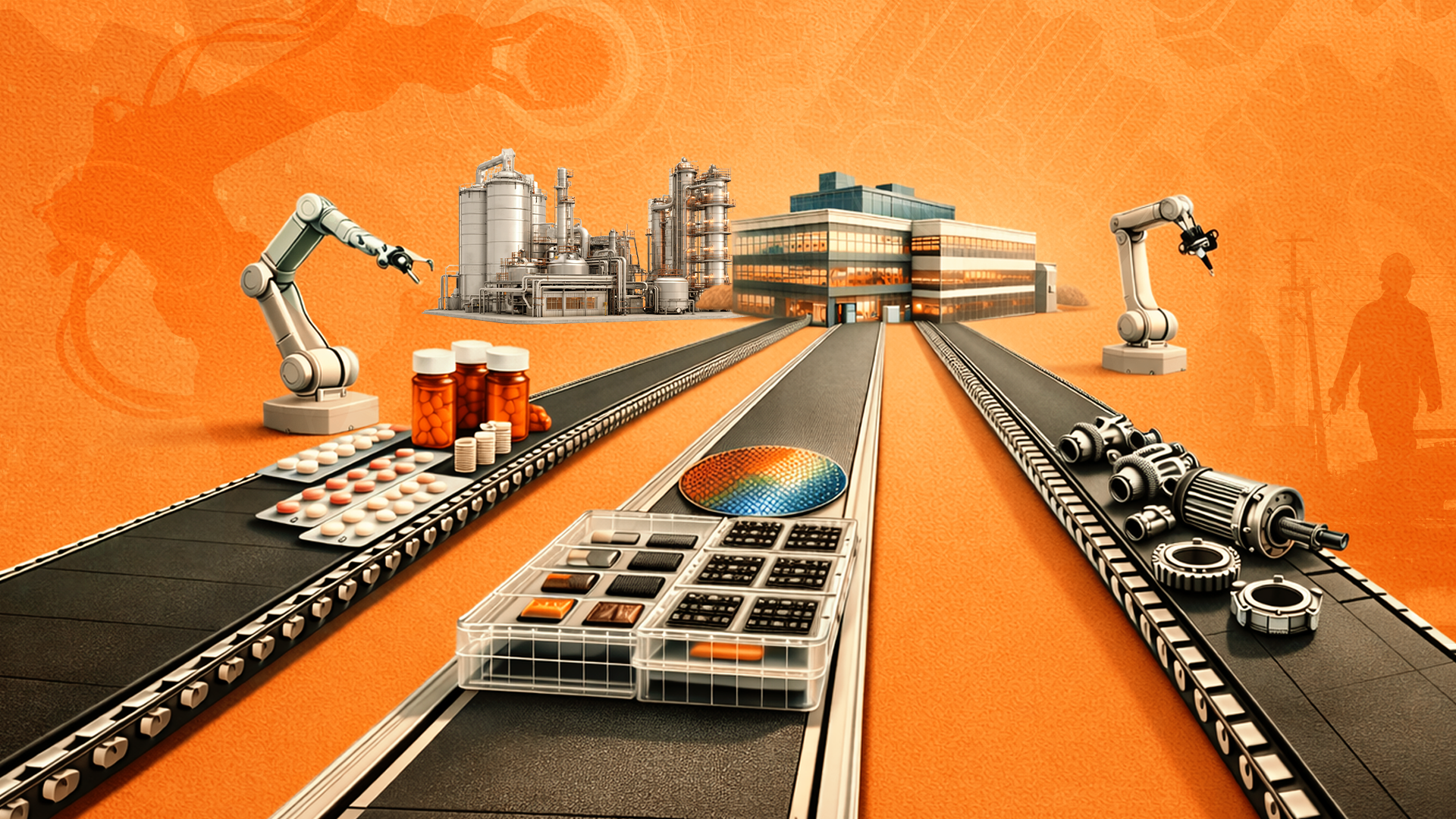
Driven by policy reforms, targeted incentives, and a renewed focus on cluster-based industrial development, India’s manufacturing sector is undergoing transformation. New hubs are emerging across states under flagship programmes like Make in India, Production Linked Incentive (PLI) schemes, and the expansion of industrial corridors. These Make in India manufacturing clusters—spanning electronics, semiconductors, pharmaceuticals, automobiles, textiles, and biomedical industries—are supported by robust infrastructure, skilled talent, and government facilitation.
The spotlight is on the emerging manufacturing clusters in India 2025, which combine global investment interest with India’s domestic capacity-building agenda. From the electronics manufacturing corridors in Uttar Pradesh to the semiconductor zones in Gujarat and the nationwide PM MITRA textile parks, India’s industrial landscape is being reshaped. These seven ecosystems are set to become the foundation of India’s ascent as a global manufacturing powerhouse.
Uttar Pradesh: India’s electronics & semiconductor powerhouse
Uttar Pradesh is rapidly emerging as a premier electronics and semiconductor powerhouse, leveraging government-approved Electronics Manufacturing Clusters (EMCs) across Noida, Greater Noida, Jewar, and the Yamuna Expressway. This electronics manufacturing cluster India UP region already accounts for approximately 55% to 60% of all mobile phones made in the country and about 55% of mobile components.[1]
The state’s commitment is evident in major new projects: a ₹417 crore EMC (2.0) in Gautam Buddha Nagar, approved by the central government, is expected to attract ₹2,500 crore in additional investment and generate 15,000 jobs.[2] The state has also become a strategic centre for chip manufacturing, hosting a ₹3,706 crore HCL-Foxconn semiconductor plant near Jewar International Airport, with a design capacity of 36 million display driver chips per month.[3]
Backed by strong infrastructure, including connectivity through the Delhi–Mumbai Industrial Corridor, expressways, and the upcoming Noida International Airport at Jewar, the region is positioning itself as a highly competitive destination for high-tech investments.
Gujarat: India’s semiconductor and pharma capital
Gujarat has long established itself as a multi-sector manufacturing powerhouse spanning semiconductors, pharmaceuticals, and automobiles. The state anchors India’s semiconductor ambitions, hosting the ₹91,000 crore Tata Electronics–Powerchip Semiconductor Manufacturing Corporation (PSMC) of Taiwan fabrication plant in Dholera[4] and Micron Technology’s $2.75 billion ATMP (Assembly, Testing, Marking, and Packaging) facility in Sanand,[5] both slated to begin production by late 2025.
As part of the larger UP–Gujarat pharma manufacturing cluster driving India’s pharmaceutical expansion, Gujarat’s pharmaceutical hubs—spread across Ahmedabad, Vadodara, Bharuch, Ankleshwar, and Vapi—generate an annual turnover of around ₹1.42 trillion as of March 2023, accounting for roughly 35% of India’s total pharmaceutical market valued at ₹4 trillion.[6] These hubs are major producers of APIs, formulations, and biotech products, reinforcing Gujarat’s role as a leading contributor to India’s global pharmaceutical exports.
Furthermore, the automotive and EV ecosystem is also expanding swiftly around Sanand, especially with Tata Motors starting operations at its newly acquired Ford facility to bolster its EV pipeline. With world-class infrastructure, SEZs, industrial corridors, and investor-friendly policies, Gujarat continues to attract high-value manufacturing investments across sectors.
Tamil Nadu: The automotive and EV manufacturing titan
Tamil Nadu’s established automotive leadership is evolving rapidly towards electric mobility. As one of the foremost automotive manufacturing hubs in India, the state’s Chennai–Oragadam–Sriperumbudur belt – already a major global hub for vehicle and component exports – is now integrating EV clusters for battery cells, electric two-wheelers, and commercial vehicles.[7] The state is among the top contributors to India's automobile exports and is speeding up its transition under the EV Policy 2023.[8] Additionally, dedicated EV and battery parks near Hosur and Krishnagiri are drawing major investments in cell and component manufacturing.
Beyond vehicles, Tamil Nadu is also a leader in diversified manufacturing, contributing a commanding 41% of India's electronic exports and a leading 38% of India’s footwear exports.[9]
Supported by strong incentives under the State’s EV and Electronics Hardware Manufacturing Policies – aligned with the PLI scheme – Tamil Nadu remains a key driver of high-value manufacturing growth, backed by world-class ports and logistics, and one of the highest numbers of industrial workers in the country.
Telangana: Biomedical & life sciences manufacturing frontier
Telangana is cementing its position as a global biomedical and life sciences hub, with Hyderabad ranked among the world’s top seven clusters.[10] Valued at over $80 billion, the state’s ecosystem is anchored by Genome Valley and the Medical Devices Park, and is home to 2,000 companies and more than 250 US FDA-approved facilities, which is the highest concentration globally.[11]
Since late 2023, Telangana has undertaken strategic initiatives—including implementing robust policies and strengthening infrastructure—that have attracted over $6.5 billion (₹54,000 crore) in new investments and created around 200,000 jobs.[12]
Under the Life Sciences Policy 2023–28, Telangana aims to expand its life sciences economy to $250 billion by 2030, integrating semiconductor and electronics expertise to promote medtech innovation through initiatives like BioDesign, thereby further cementing Hyderabad’s status as the “vaccine capital of the world.”[13]
Maharashtra: Multi-sector manufacturing and smart industrial parks
Maharashtra remains India’s primary industrial powerhouse, contributing nearly 14% to the national GDP, a share greater than the entire GDP of several countries.[14] The state accounts for over 13.8% of India’s industrial output[15] and is anchored by major centres such as Mumbai, Pune, and Nagpur. Maharashtra leads in the automotive, electronics, engineering, pharmaceuticals, and FMCG sectors. It also hosts numerous industrial corridors — including the Delhi–Mumbai and Bengaluru–Mumbai Industrial Corridors — along with more than 400 industrial estates, supported by a robust logistics and port network.
Furthermore, the Pune-Aurangabad-Nashik belt remains India’s centre for automotive and precision engineering, while the Nagpur-Aurangabad corridor, particularly the Shendra Bidkin Industrial Area (AURIC), is emerging as a model smart industrial park. Recent reforms, including the Maharashtra Industrial Policy 2023 and EV Policy 2025, are boosting sustainable, high-tech manufacturing. These measures are boosting investor confidence and establishing the state as a leading destination for advanced, multi-sector industrial investments.
Karnataka: Aerospace and R&D powerhouse
While celebrated as India’s "Silicon Valley," Karnataka is rapidly forging its position as a deep-tech manufacturing and engineering powerhouse. The state's economic muscle extends far beyond IT into high-growth sectors, particularly aerospace, defence, and precision engineering. Bengaluru and its surrounding regions boast a dense ecosystem that includes major defence Public Sector Undertakings (PSUs), over 100 global fabless chip design firms, and a concentration of multinational R&D centres unmatched in India.[16]
The state is actively developing specialised clusters, including the Aerospace Park near Bengaluru International Airport, to support maintenance, repair, overhaul (MRO), and component manufacturing. Leveraging its deep talent pool in IT and engineering, Karnataka is a key destination for high-value, complex manufacturing that integrates advanced hardware with cutting-edge software and design capabilities.
PM MITRA Textile Parks: The fabric of future manufacturing
India’s textile sector is entering a new era with the launch of seven PM MITRA (Mega Integrated Textile Region and Apparel) Parks, a flagship Make in India initiative. Strategically located across Tamil Nadu (Virudhnagar), Telangana (Warangal), Gujarat (Navsari), Karnataka (Kalaburagi), Madhya Pradesh (Dhar), Uttar Pradesh (Lucknow), and Maharashtra (Amravati), these parks are expected to attract over ₹70,000 crore in investment and create one million jobs.[17]
Built around the “5F” vision – Farm to Fibre to Factory to Fashion to Foreign – the parks integrate the complete textile value chain with world-class, plug-and-play infrastructure. This cluster-based approach aims to reduce logistics costs, improve efficiency, and enhance global competitiveness, positioning India as a leading hub for textile manufacturing and exports.
Conclusion
India’s manufacturing landscape is being transformed by strategic, cluster-based development across electronics, semiconductors, pharmaceuticals, automotive, textiles, biomedical, and aerospace sectors. State-level initiatives, supported by central policies such as Make in India, PLI schemes, industrial corridors, and SEZs, are establishing world-class infrastructure, integrated supply chains, and skilled workforces.
By 2025, Uttar Pradesh, Gujarat, Tamil Nadu, Telangana, Maharashtra, Karnataka, and the PM MITRA textile parks will not only serve as regional growth engines but also become globally competitive hubs, attracting high-value investments, advanced technology, and innovation-driven industries. Together, these clusters highlight India’s clear shift from policy planning to production leadership, positioning the country as a key player in the global industrial ecosystem.
This listicle is written by Bhavya Tyagi