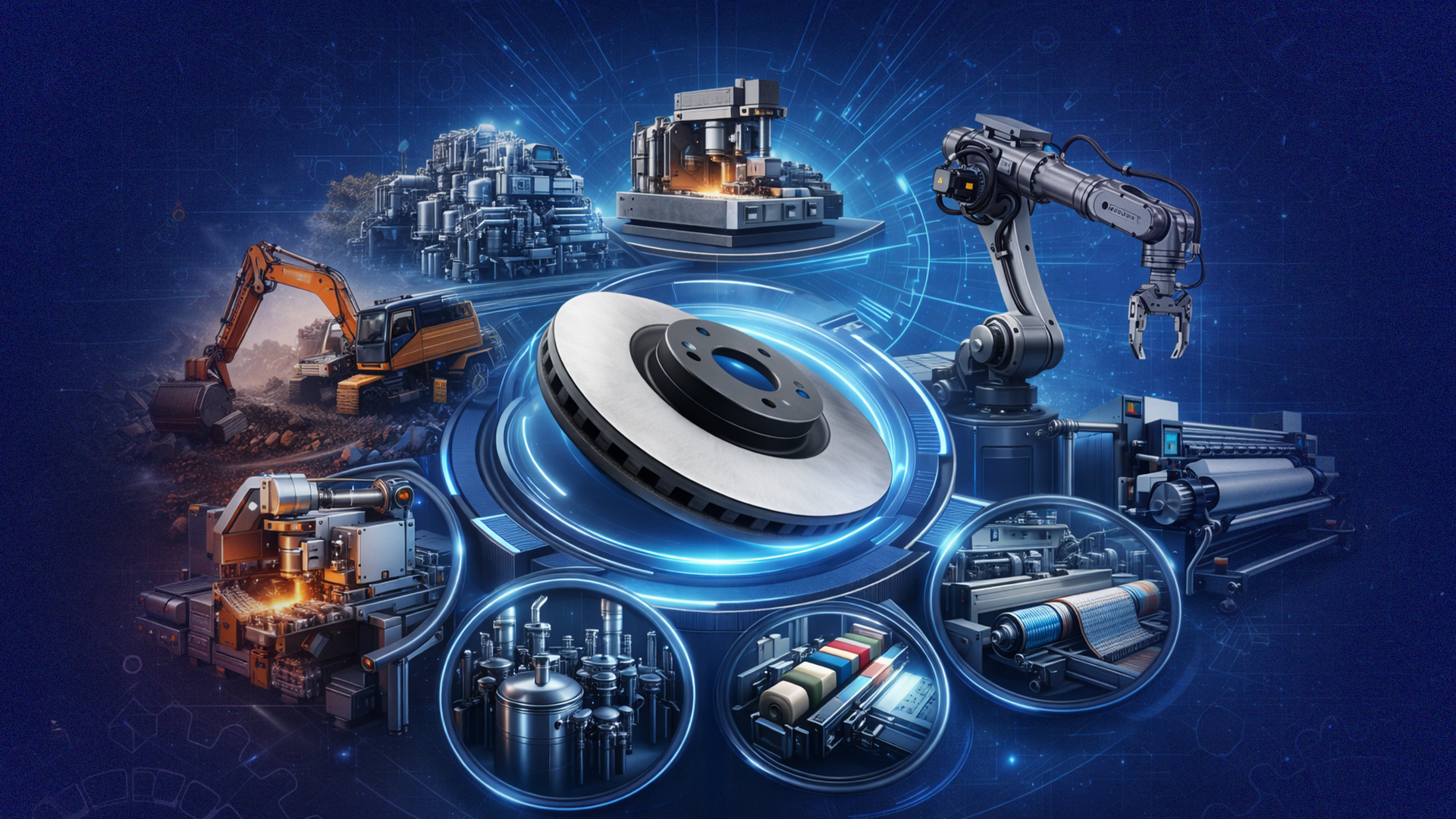
The Machines That Make the Nation
Capital goods—comprising plant, machinery, and equipment used across manufacturing and services—enable capacity creation across industries. From metro systems and renewable energy parks to automotive plants and electronics manufacturing units, heavy engineering capabilities ultimately determine the scale, productivity, and technological depth of industrial activity.
The sector currently contributes approximately 1.9% to India's GDP.[1] While this share appears modest, its multiplier effect is significant. A strong domestic capital goods base reduces import dependence, enhances supply chain resilience, and supports higher-value-added manufacturing across the economy.
For decades, India's growth narrative was driven by services and consumption. That paradigm is now shifting. Today, the story of India's economic transformation is increasingly written in steel, precision engineering, and industrial capability—positioning capital goods as a strategic pillar of the country's industrial sovereignty.
Evidence of this shift is visible in industrial indicators. With the Index of Industrial Production (IIP) for capital goods surging by 8.1%[2] in late 2025—perfectly mirroring manufacturing growth[3]. This signals not a temporary spike but the early stages of a structural industrial build-out aligned with India's ambition to become a global manufacturing hub.
This momentum is also visible in production trends. Sector output has nearly doubled over the past decade, reaching ₹4,29,001 crore in 2023–24.[4] At the same time, Production Linked Incentive (PLI) schemes have attracted over ₹2 lakh crore in realised investments as of September 2025,[5] creating strong upstream demand for advanced machinery, robotics, and specialised engineering systems supplied by the capital goods ecosystem.
Infrastructure-Led Industrial Demand
A key driver of this transformation is the government's sustained push toward infrastructure-led growth. Public capital outlay has expanded a staggering 4.2 times since FY18, rising from ₹2.63 lakh crore to a proposed ₹12.2 lakh crore in the Union Budget FY 2026–27.[6]
This investment is complemented by large national programmes such as the National Infrastructure Pipeline (NIP), which envisages investments of over ₹111 lakh crore across sectors including energy, transport, urban infrastructure, and logistics.[7]
These initiatives require significant heavy engineering inputs—including industrial machinery, power equipment, material handling systems, construction equipment, and process engineering solutions—creating sustained long-term demand for capital goods manufacturing. While imports of advanced machinery grew by 13.4% in Q3 FY26, this[8] for a strategic investor, represents a "localization map"—a clear signal of exactly where domestic capacity is waiting to be built.
Subsector Opportunities Across the Capital Goods Ecosystem
India's capital goods sector spans multiple specialised segments, each supported by distinct demand drivers and policy initiatives.
Construction and Infrastructure Equipment (CIE): India is the world's third-largest market for construction equipment.[9] The Scheme for Enhancement of Construction and Infrastructure Equipment (CIE) aims to strengthen domestic manufacturing of high-value machinery such as tunnel-boring systems and advanced hydraulics.
Power and Electrical Equipment: The largest sub-segment of India's capital goods sector, it is driven by grid modernisation and the country's 500 GW non-fossil capacity target by 2030.[10] Transformers and transmission equipment have recorded consistent growth, while emerging opportunities lie in grid-scale battery storage and smart grid technologies, where domestic manufacturing capacity remains limited. Recent customs duty exemptions for machinery used in lithium-ion cell manufacturing and critical mineral processing have aligned capital goods with the global EV and renewable storage revolution.[11]
Machine Tools and Precision Engineering: India's machine tools market stood at US$1.5 billion in 2023 and is projected to reach US$3.2 billion by 2032.[12] Initiatives such as the Tumakuru Machine Tools Park and SAMARTH Industry 4.0 centres are strengthening domestic precision manufacturing capabilities. To move up the value chain, the Ministry of Heavy Industries is also establishing digitally enabled Hi-Tech Tool Rooms.
Process Plant Equipment: The sector has an estimated manufacturing capacity of around US$6 billion per annum,[13] with Indian firms supplying pressure vessels, heat exchangers, and modular process units to industrial projects worldwide. Increasing integration into global EPC supply chains, particularly across the Middle East and Africa, is expanding opportunities in high-value equipment such as cryogenic systems and specialised pressure vessels.
Battery and EV Manufacturing Equipment: Equipment for lithium-ion cell manufacturing and battery assembly represents one of the fastest-growing opportunities. The PLI-ACC scheme's ₹18,100 crore commitment[14] is expected to drive demand for cell manufacturing lines, testing systems, and battery management technologies. Cell manufacturing lines, battery assembly systems and battery management system testing infrastructure barely exist in India today. India's first battery and BMS testing facility, established at ARAI Pune under the Capital Goods Scheme, is the opening move.[15]
Technology transition and Industry 4.0
The sector is also undergoing a technological transformation through the adoption of Industry 4.0 technologies, including automation, digital manufacturing, robotics, and advanced materials.
Indian manufacturers are increasingly integrating smart manufacturing systems, IoT-enabled equipment, and predictive maintenance technologies to improve operational efficiency and productivity.
The Policy Environment: Built for Long-Term Capital
India's policy framework for capital goods investment is designed to support long-term industrial partnerships. The sector does not require industrial licensing, and 100% FDI is permitted under the automatic route (except for land-border countries). There are no restrictions on royalty payments, technology transfer fees, or design remuneration for foreign collaborators. Machinery—both new and used—can be imported freely, with a maximum basic customs duty of 7.5%, alongside preferential rates under India's expanding FTA network and Project Imports facility.
A Strategic Opportunity for Global Manufacturers
Global supply chain diversification and India's expanding domestic market are strengthening the country's attractiveness as a manufacturing destination.
India offers several structural advantages for capital goods manufacturing:
- A large and expanding domestic market
- Competitive engineering talent and technical workforce
- Expanding industrial infrastructure
- Strong policy support for manufacturing and exports
The top five destinations for engineering goods exports in FY25 were the USA, UAE, Saudi Arabia, Germany and Italy[16]— a geographically and economically diversified buyer base that signals sustained demand well beyond India's domestic cycle.
India's policy framework for capital goods investment is designed to support long-term industrial partnerships. The sector does not require industrial licensing, and 100% FDI is permitted under the automatic route (except for land-border countries). For global investors, the opportunity spans the entire value chain—from large-scale OEM manufacturing in construction equipment, power systems, and industrial machinery to precision components, automation solutions, and advanced engineering systems. This is not a short-term investment cycle. It represents a structural industrial build-out supported by infrastructure investment, manufacturing incentives, the energy transition, and expanding global supply chains.
As India enters its next phase of industrialisation, capital goods will play a defining role in shaping the country's manufacturing capability, technological depth, and global competitiveness. Heavy engineering is no longer simply an industrial sector—it is the foundation of India's next decade of economic growth.
This blog is written by Shanvi Gupta