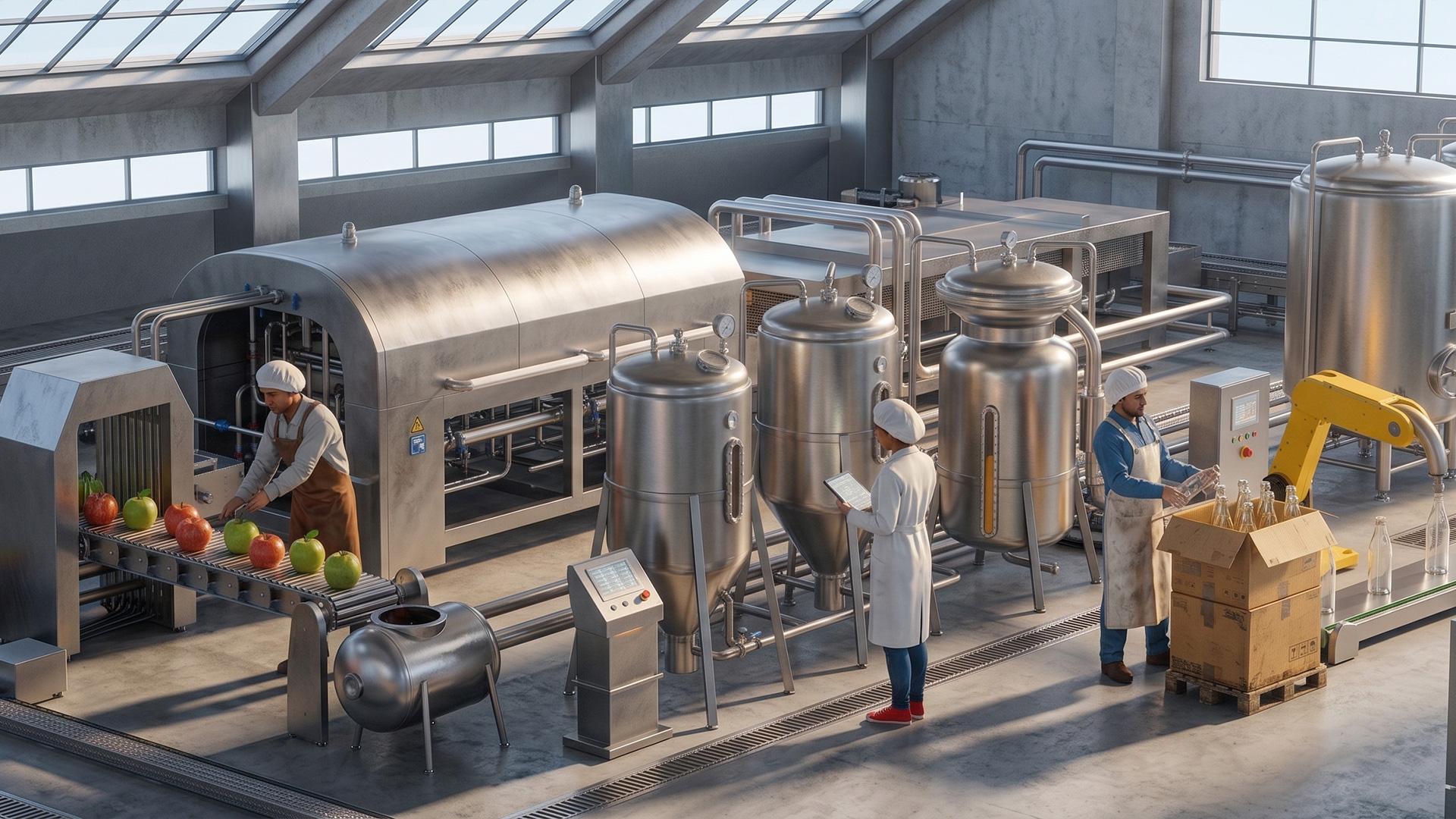
India's food processing sector is entering a decisive decade. With one of the world's largest agricultural bases and a rapidly expanding consumer market, the country is transforming how food moves from farms to domestic shelves and global markets. Over the past decade, a series of structural reforms focused on simplifying regulations, strengthening infrastructure, rationalizing taxation, formalizing enterprises, and attracting long-term investment has shifted the sector from fragmented and supply-driven to integrated, investment-ready, and globally competitive.
For investors, this transformation is significant. It reflects the emergence of three critical enablers: policy predictability, scalable infrastructure, and strong demand fundamentals, the foundation for long-term capital deployment in food processing.
The food processing sector has a strategic position within India's economy, bridging agriculture and industry while linking domestic consumption with export markets. In 2023–24, the sector contributed 7.93% of manufacturing Gross Value Added (GVA) and 9.46% of agriculture GVA. Sectoral GVA increased from ₹1.30 lakh crore in 2013–14 to ₹2.24 lakh crore in 2023–24.[1] This expansion reflects rising value addition, stronger supply chains and improving industrial capacity.
The reforms have been anchored around three core priorities: minimizing post-harvest losses, enhancing processing capacity, and strengthening the ease of doing business, resulting in a more efficient, integrated, and investor-friendly food processing ecosystem.
Liberalized FDI and policy simplification
One of the most significant structural reforms has been the liberalization of foreign direct investment. India permits 100% FDI in the food processing and food retail industry.[2] This policy framework provides clarity and openness for international investors seeking to integrate manufacturing and distribution operations.
The impact of this liberalized regime is evident in investment trends. FDI inflows into India's food processing sector have demonstrated a strong upward trajectory, rising from ₹3,164.72 crore in 2014–15[3] to a cumulative ₹67,917 crore[4] during April 2014 to March 2025. This sustained capital infusion underscores growing investor confidence and the sector's expanding potential. Beyond capital inflows, the government has also digitized administrative processes, improving the regulatory certainty for investors.
Production Linked Incentive (PLI) Scheme: Scaling global food champions
To accelerate scale and global competitiveness, the government introduced the Production Linked Incentive Scheme for Food Processing Industries (PLISFPI) with an outlay of ₹10,900 crore for the period FY2021–22 to FY2026–27.[5] The scheme has incentivized manufacturing in key segments, including ready-to-cook and ready-to-eat foods, such as millet-based products, processed fruits and vegetables, marine products, and dairy, such as mozzarella cheese. It has also supported innovative and organic SME products and assisted with branding and marketing abroad.
As of January 2026, 169 applications have been approved under the PLI scheme, with approved applicants having cumulatively invested ₹9,207 crore and ₹2,162.55 crore disbursed as incentives. The scheme has created processing and preservation capacity of around 35 lakh metric tons per annum and generated employment for approximately 3.39 lakh, including direct and indirect jobs.[6]
Export performance has strengthened significantly, with processed food products supported under PLISFPI recording a compound annual growth rate of 13.23% between 2019–20 and 2024–25.[7] In addition, support for overseas branding and marketing, including reimbursement of eligible expenses, has further enhanced global market penetration.
Pradhan Mantri Kisan SAMPADA Yojana: Building integrated infrastructure
Infrastructure development has been central to improving operational efficiency in food processing. The Pradhan Mantri Kisan SAMPADA Yojana (PMKSY), launched in 2015 with an approved outlay of ₹6,520 crore, serves as an umbrella scheme for building integrated cold chains, Agri-processing clusters, food testing laboratories and supply chain linkages.[8]
In all so far, a total of 1,618 projects has been approved across components of PMKSY scheme, of which 1,185 are operational, creating a processing and preservation capacity of 270.51 lakh MT. These projects are expected to leverage investments of ₹21,917 crore, benefiting around 51 lakh farmers and generating over 7.22 lakh direct and indirect employment.[9] Additionally, the scheme has a budget outlay of ₹1,000 crore under the ICCVAI component to support the establishment of 50 multi-product food irradiation units.[10]
By strengthening backward and forward linkages from the farm gate to the retail outlet, PMKSY aims to reduce post-harvest losses and enhance price realization for farmers.
Strengthening food testing and quality standards
The Union Cabinet has also approved a budget for help establishing of 100 Food Testing Labs (FTLs) with NABL accreditation under the component scheme - Food Safety and Quality Assurance Infrastructure (FSQAI) of Pradhan Mantri Kisan Sampada Yojana (PMKSY), in alignment with the budget announcement for FY 2024-25.[11]
These measures not only align India's processing infrastructure with international quality standards but also reduce uncertainty in export-oriented manufacturing.
Formalising micro enterprises: PMFME Scheme
The formalisation of micro enterprises is another pillar of reforms in the food processing sector. The Pradhan Mantri Formalisation of Micro Food Processing Enterprises (PMFME) scheme, launched in 2020 with an outlay of ₹10,000 crore, aims to support micro units through credit-linked subsidies, capacity building and branding assistance.[12]
Under the PMFME Scheme, 59,202 micro food processing enterprises have been formalized as of December 2025, with ₹17,015.8 crore in investments mobilized. The scheme has generated over 2.8 lakh jobs, increased beneficiary turnover by 1.7 times, and strengthened market access, supported by expanding infrastructure, credit facilitation, and targeted government interventions.[13]
The scheme promotes the 'One District One Product' approach and improves access to institutional finance for unorganized enterprises. By strengthening the micro-enterprise base, PMFME enhances value chain integration and builds a more resilient supplier ecosystem. This formalisation improves traceability, quality, and access to financing across the sector.
GST reforms: Lower costs and stronger supply chains
A more favorable tax architecture has been instrumental in reducing costs in the food processing industry. Recent GST rationalization has reduced tax rates from 5% to nil on items such as UHT milk, prepackaged and labelled paneer/chhena, and traditional Indian breads (including chapati, roti, and paratha), while a wide range of processed foods such as packaged namkeens, sauces, pasta, instant noodles, chocolates, coffee, preserved meat, cornflakes, butter, and ghee have seen rates lowered from 12-18% to 5%.[14] By bringing most food products under minimal tax brackets, the government has cleared the path for stronger supply chains, as GST reductions were extended to packaged food items, snacks, dairy products and beverages, while several staple items were exempted.[15]
The reforms also reduced GST on packaging materials to 5% and lowered GST on commercial goods vehicles from 28% to 18%. These reforms reduce both input and logistics costs for food processors, improve margins, enable more competitive pricing, and enhance overall supply chain efficiency.
Market growth and demand fundamentals
Robust demand fundamentals continue to reinforce strong policy momentum. The India's food processing market size reached ₹30.49 lakh crore in 2024 and is expected to reach ₹65.24 lakh crore by 2033, exhibiting a growth rate (CAGR) of 8.38% during 2025-2033 (as per IMARC).[16] This Growth of Food Processing market is driven by rising urbanization, shifting consumption patterns and growing demand for convenient, health-oriented and value-added products.
Food Processing sector accounts for 20.4% of exports in total Agri-food exports in 2024-25 with exports reaching ₹4.18 lakh crore.[17] From 2014 to 2025, India's Agri and food exports have witnessed significant growth. Exports of processed foods have increased fourfold, fruit and pulses exports have tripled, processed vegetable exports have quadrupled, cocoa exports have tripled, and cereal exports have doubled. Rice exports alone have grown by 62 percent during this period.[18]
Conclusion: A competitive and investment-ready ecosystem
Ease of doing business in India's food processing sector is no longer driven solely by policy intent. Institutional and financial support mechanisms have reinforced sectoral reforms and strengthened on-the-ground execution.
The convergence of Liberalized FDI; Targeted incentive schemes; Integrated infrastructure development; Tax rationalization and Strong domestic demand has created a sector that is both investment-ready and globally competitive.
Supported by a large and diversified agricultural base, rising domestic consumption and sustained policy continuity, India's food processing sector presents significant opportunities across value-added foods, dairy, marine products, millets, cold chains, logistics and packaging.
India's food processing industry is no longer defined by its constraints, but by its capacity to scale. For investors, the opportunity is clear: participate in a market that is transitioning from volume to value and from potential to sustained performance.