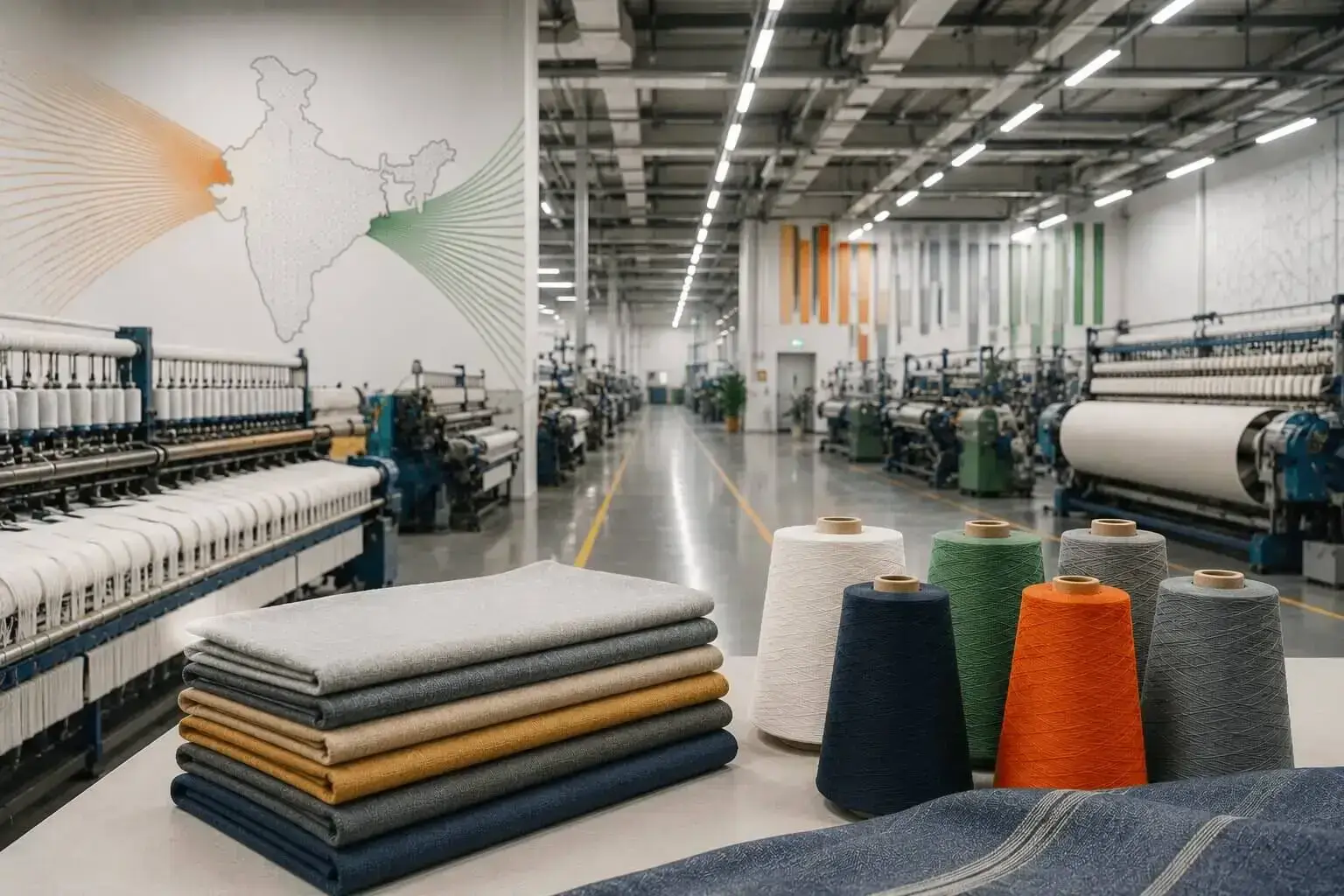
India's textile sector has entered a phase defined by scale, infrastructure, technology and deeper integration with global value chains. For investors, the opportunity extends beyond the country’s large domestic market and established manufacturing base to include policy-backed incentives, integrated textile parks, technical textiles and an expanding export ecosystem.
The investment proposition is supported by several complementary developments: 100% FDI through the automatic route, the Production Linked Incentive (PLI) Scheme for MMF apparel, MMF fabrics and technical textiles, the PM Mega Integrated Textile Region and Apparel (PM MITRA) Parks, technical textiles research and development, and large-scale skilling initiatives. Together, these measures are designed to strengthen India's competitiveness across the textile value chain.
Within the broader textile market in India, foreign investment inflows, staged production incentives, and multi-year infrastructure programmes have moved in the same direction over the past several years. That alignment is part of why the textile sector in India continues to be evaluated by investors on a longer time horizon than many comparable manufacturing sectors, and why India textile production is increasingly discussed alongside terms like capital efficiency and value creation rather than simply cost arbitrage.
Foreign Investment in the Textile Sector of India
India permits 100% Foreign Direct Investment in textiles and apparel through the automatic route, meaning foreign investors do not require prior government approval to enter the sector.[1] Cumulative FDI equity inflow into the textiles sector (including dyed and printed textiles) stood at ₹33,512.66 crore, approximately USD 5,073.03 million, between April 2000 and March 2026, reflecting more than two decades of continuous, if measured, foreign participation in the sector rather than a recent spike.[2]
In FY 2024-25 alone, the sector recorded FDI equity inflow of ₹2,175.70 crore, approximately USD 254.77 million, ranking 26th among all sectors tracked by the Department for Promotion of Industry and Internal Trade and accounting for 0.51% of India's total FDI equity inflow that year.[3]
These figures place textiles within a wider basket of manufacturing sectors that the government has prioritized for capital inflows, alongside a broader national FDI equity inflow of ₹5,16,936 crore (USD 58,846 million) in FY 2025-26.[2]
Production-Linked Incentives in Textiles
Scheme projections
The Production Linked Incentive (PLI) Scheme for Textiles, notified in September 2021 with an approved outlay of ₹10,683 crore, is designed to promote production of MMF apparel, MMF fabrics and technical textile products, enabling the sector to achieve greater scale and competitiveness. According to the Ministry of Textiles' PLI portal, 170 applicants have been selected, representing proposed investment of ₹41,533 crore, projected turnover of ₹2,75,053 crore and projected employment of 3,67,427. [4]
| Target Segment | Number of Applicants | Investment (Rs. in cr.) | Turnover (Rs. in cr.) | Employment (No's) |
| MMF Fabrics | 38 | 6,087 | 40,865 | 32,557 |
| MMF Apparel | 43 | 7,613 | 64,435 | 214,665 |
| Technical Textiles | 89 | 27,832 | 169,753 | 120,205 |
| Total | 170 | 41,533 | 275,053 | 367,427 |
Infrastructure Designed for Long-Gestation Capital
The PM Mega Integrated Textile Region and Apparel (PM MITRA) scheme, with an outlay of ₹4,445 crore for the period 2021-22 to 2027-28, is structured to de-risk long-horizon manufacturing investment across seven sites in Tamil Nadu, Telangana, Gujarat, Karnataka, Madhya Pradesh, Uttar Pradesh, and Maharashtra.[5] The scheme provides Development Capital Support of up to ₹500 crore per Greenfield park (₹200 crore for Brownfield sites) and Competitive Incentive Support of up to ₹300 crore per park to individual investing units, financial mechanisms aimed specifically at investors committing capital to a multi-year industrial build-out.[6]
As of a February 2026 government update, ₹3,862 crore in investment had already been grounded at the Telangana site, and Dhar, Madhya Pradesh had drawn a proposed investment of ₹24,175 crore against 1,150 acres of allotted land.[7] Across all seven parks, investment MoUs with a combined potential of over ₹27,434 crore had been signed, with 100% of land acquired and handed over to the respective project vehicles.[8] On May 10, 2026, the PM MITRA Park at Warangal, Telangana, was inaugurated as the country’s first functional PM MITRA Park, marking a significant milestone in the programme’s implementation.[9]
Across all seven sites, the scheme's original design envisaged nearly ₹70,000 crore in eventual investment and 20 lakh in employment generation, a scale of ambition that positions PM MITRA as a multi-year, rather than a single-project, infrastructure commitment.[5]
Capital Directed Toward Technical Textiles R&D
A share of long-term capital in the sector is being directed toward research rather than solely toward manufacturing capacity. The National Technical Textiles Mission, launched in 2020-21 with the explicit aim of positioning India as a global leader in technical textiles, supports 168 research projects with a combined value of ₹509 crore, alongside a target of skilling 50,000 individuals in the segment.[14]
Technical textiles, functional fabrics used in defence, healthcare, infrastructure, and automotive applications, are also the segment the PLI Scheme identifies as more capital-intensive than conventional MMF apparel or fabrics, which is consistent with why 56.75% of PLI-selected companies fall into this category.[4] Research-linked funding of this kind is a further signal that some capital entering the sector is being allocated toward product development and export capability rather than production volume alone.
A Workforce Base Built to Absorb Capital
Capital committed to manufacturing capacity depends on a workforce that can be deployed at scale. India's textile industry provides direct employment to over 45 million people and supports the livelihoods of over 100 million more, including a significant proportion of women and rural workers.[10]
The Ministry's SAMARTH scheme (Scheme for Capacity Building in Textile Sector) has skilled 5.41 lakh people, with women accounting for 88% of beneficiaries, according to the Ministry's 2025 year-end review. The Ministry has set a target of skilling an additional 2 lakh people under the scheme in FY 2025-26.[11]
This skilling pipeline is distributed across regional manufacturing clusters that function as a textile hub of India for specific parts of the value chain, supporting both the indigenous fabric industry in India and capacity tied to foreign and PLI-linked investment.
Returns Showing Up in Trade Performance
Export performance provides another indicator of the sector's international competitiveness. India's textile and apparel exports, including handicrafts, reached USD 37.8 billion in 2024-25, registering 5% growth over the previous year and generating a trade surplus of USD 28.2 billion.[4]
India accounted for 4.1% of global trade in textiles and apparel in 2024, as the world's sixth-largest exporter, with the sector contributing 8.63% of India's total exports that year. [4] A trade surplus of this scale indicates that India's textile production is not merely import-substituting but generating net foreign exchange, a factor long-term investors weigh alongside domestic policy incentives.
Policy Consistency Underpinning Long-Term Capital
Policy support for the sector continues to combine investment incentives, manufacturing infrastructure, skilling and export facilitation. The Union Budget 2026-27 provides ₹5,279.01 crore for the Ministry of Textiles, compared with a Budget Estimate of ₹5,272 crore for 2025-26.[12] Several capital-linked schemes have also been extended rather than allowed to lapse: the National Technical Textiles Mission, with an outlay of ₹1,480 crore, has been extended to March 2026,[13] and the SAMARTH skilling scheme has similarly been extended, for a further two years, to March 2026.[15]
This pattern of extension, rather than discontinuation, is a structural feature of how India's textile production base and Indian fabric industry are financed over multi-year cycles.
Sector Outlook
India's textile opportunity is increasingly defined by the breadth of its ecosystem rather than by manufacturing cost alone. A large and diverse production base, 100% FDI through the automatic route, PLI-linked investments, integrated PM MITRA parks, growing technical-textiles capabilities, a large workforce and strong export linkages together create multiple entry points for investors across the value chain.
As India seeks to build a USD 350 billion textile and apparel industry by 2030 [14], the opportunity extends from fibre and yarn to MMF, technical textiles, processing, apparel and integrated manufacturing. For global companies evaluating resilient manufacturing and supply-chain strategies, India's evolving textile ecosystem offers opportunities to participate in both domestic demand and global value chains.