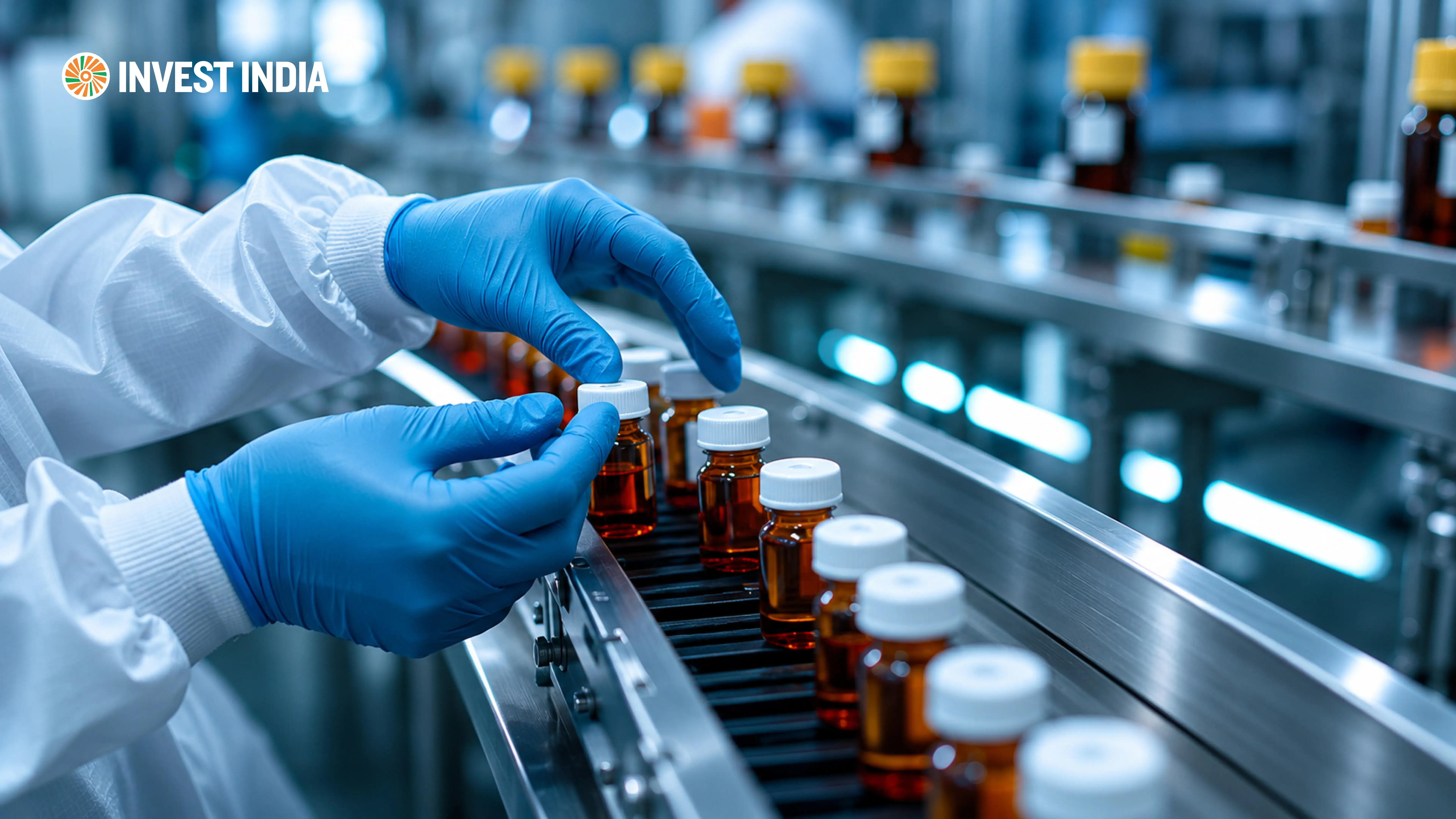
India is a major global pharmaceutical manufacturing hub, with established capabilities in generic medicines, APIs, vaccines, and formulations. Its established supply base and access to international markets make it a strategic location for global companies looking to expand manufacturing operations.
Investment opportunities are expanding across critical APIs, fermentation-based antibiotics, specialized technologies, and pharmaceutical quality infrastructure. Initiatives such as the Bulk Drugs PLI Scheme, dedicated Bulk Drug Parks and the National Action Plan on Antimicrobial Resistance 2.0 (2025-29), create opportunities for foreign manufacturers, technology providers and pharmaceutical service companies to invest in India.[1][2][3][5]
Key Takeaways
- India permits up to 100% FDI through the automatic route in greenfield pharmaceutical projects.[1]
- Foreign companies can explore API manufacturing, antibiotic production, joint ventures and brownfield acquisitions.[1][9]
- Three Bulk Drug Parks are being developed in Andhra Pradesh, Gujarat and Himachal Pradesh.[5]
- Investment opportunities extend to fermentation technology, pharmaceutical testing and digital traceability.[6][7][8]
- Manufacturing licences, GMP compliance and environmental approvals remain essential before operations begin.[6][7][11]
- Global investors can explore opportunities across areas such as critical APIs and intermediates, fermentation-based antibiotics, bulk drug park infrastructure, pharmaceutical quality and testing, and digital traceability technologies.
Where Global Investors Can Participate in India’s Pharmaceutical Sector
India’s pharmaceutical ecosystem offers several entry points for international companies, depending on their manufacturing capabilities, technology, and investment objectives. Five such areas that offer relevant opportunities are: critical drug ingredients, antibiotic manufacturing, shared industrial infrastructure, pharmaceutical quality systems, and digital traceability.
Critical APIs, Key Starting Materials and Drug Intermediates
India offers opportunities for foreign pharmaceutical companies to establish manufacturing facilities for APIs, key starting materials (KSMs) and drug intermediates. The PLI Scheme for Bulk Drugs has an approved outlay of ₹6,940 crore and covers 41 identified critical products. As of December 2025, 48 greenfield projects had been approved and 38 had been commissioned.[3]
The government reported further manufacturing activity in September 2026, including a greenfield Atorvastatin API facility established by Centrient Pharmaceuticals India Private Limited in Punjab. The project represents an investment of ₹161.13 crore and has an installed capacity of 206 metric tonnes per annum.[4]
Global companies can evaluate greenfield projects, joint ventures, process technology partnerships and backward integration into critical intermediates. The approved PLI projects demonstrate investment activity, but do not mean that new applicants can automatically access incentives.
Fermentation-Based Antibiotics and Complex APIs
Antibiotic manufacturing is a specialised opportunity within India’s critical drug supply chain. Products manufactured through commissioned PLI-supported projects include Penicillin-G, Clavulanic Acid and Rifampicin.[3]
Foreign companies with fermentation, purification and process-engineering capabilities can explore manufacturing partnerships, technology transfer, specialised equipment supply and production of antibiotic intermediates. Investors can also evaluate opportunities in quality-control systems and effluent treatment, which are important for fermentation-based facilities.
The National Action Plan on Antimicrobial Resistance 2.0 (2025–29) identifies stronger laboratory capacity, infection control and coordinated action across human, animal, agricultural and environmental sectors. It also envisages private-sector participation in implementation.[2] Investment in this segment should therefore focus on compliant manufacturing and quality systems, alongside responsible production and supply.
Bulk Drug Parks and Shared Manufacturing Infrastructure
India has approved 3 Bulk Drug Parks in Andhra Pradesh, Gujarat and Himachal Pradesh under a scheme with a ₹3,000 crore outlay. Each park is eligible for central assistance of up to ₹1,000 crore for common infrastructure. Planned facilities include power, water, steam, effluent treatment, solid-waste management, warehouses and solvent recovery systems.[5]
Foreign API manufacturers can approach the respective state implementing agencies to explore land allotment and establish production units. These include the Andhra Pradesh Industrial Infrastructure Corporation (APIIC) in Andhra Pradesh, Gujarat Industrial Development Corporation (GIDC) in Gujarat, and Himachal Pradesh Bulk Drug Park Infrastructure Ltd. (HPBDPIL) in Himachal Pradesh. The government has also reported state-level incentives such as capital subsidies, interest subsidies, GST reimbursement and stamp-duty exemptions, subject to state policies and eligibility conditions.[5]
Investors must verify land availability, utility readiness, allotment terms and project timelines before selecting a location.
Pharmaceutical Quality, Testing and Digital Traceability Infrastructure
India’s pharmaceutical sector offers investment opportunities beyond drug manufacturing, particularly in quality testing, compliance and digital traceability. In March 2026, the Ministry of Health and Family Welfare reported that 19 new government drug-testing laboratories had been constructed and 28 existing laboratories upgraded, strengthening the country’s testing and regulatory infrastructure[6].
International companies can explore opportunities in analytical and microbiological testing, stability studies, laboratory automation and specialised testing equipment. Digital traceability is another growing area. APIs manufactured or imported in India are subject to QR-code requirements at each level of packaging[7]. The expanded Schedule H2 framework will also cover antimicrobial formulations from 1 July 2028[8].
These requirements create opportunities for international technology providers to work with Indian pharmaceutical manufacturers on serialization systems, packaging-line automation, coding and verification technologies, and track-and-trace software. These are potential commercial opportunities arising from regulatory requirements, rather than separate government incentives or guaranteed contracts.
FDI Policy and Compliance Requirements for Foreign Investors
India’s FDI policy permits 100% foreign investment under the automatic route in greenfield pharmaceutical projects. For brownfield projects, up to 74% is permitted under the automatic route. Investment above 74% and up to 100% requires government approval.[1]
Brownfield investments are subject to additional conditions, including the maintenance of specified production levels and domestic supply of National List of Essential Medicines (NLEM) products, maintenance of prescribed R&D expenditure and disclosure of technology transfers. Investors from countries sharing a land border with India, or investments involving beneficial owners from such countries, are subject to government approval requirements.[9]
Foreign investors must also address the following regulatory requirements:
- Company and investment compliance: Establish an eligible Indian entity or investment structure and complete applicable Foreign Exchange Management Act (FEMA) and RBI reporting.[9]
- Manufacturing licences: Obtain the relevant licence from the State Licensing Authority under the Drugs and Cosmetics Act, 1940, and Drugs Rules, 1945. Specified new drugs may require additional central permissions.[6][10]
- Good Manufacturing Practices: Design and operate the facility in accordance with revised Schedule M requirements covering premises, plant, equipment and quality systems.[7]
- Environmental approvals: Obtain Environmental Clearance where applicable, along with Consent to Establish and Consent to Operate from the relevant State Pollution Control Board. Hazardous-waste authorisation may also be required.[11]
- Product quality and traceability: Comply with applicable API QR-code requirements, product testing, batch records and antimicrobial packaging requirements.[7][8]
The CDSCO issued a dossier-based manufacturing licence application guidance document in February 2026. Investors should use the applicable application requirements when preparing their regulatory submissions.[10]
Pre-Investment Checklist for Global Companies
- Before committing capital, international investors should verify:
- The permitted FDI route and any applicable government approval.
- Beneficial ownership and land-border investment restrictions.
- Land title, industrial zoning, utilities and infrastructure readiness.
- Product classification and the applicable manufacturing licence.
- Revised Schedule M compliance and quality-control arrangements.
- Environmental clearance, pollution-control consents and waste-management facilities.
- State-level incentives, eligibility conditions and application deadlines.
- Domestic pricing obligations, where applicable, and export-market requirements.
- Availability of skilled personnel, raw materials and logistics.
The exact approvals depend on the product, manufacturing process and project location. A project-specific regulatory assessment should precede land acquisition and construction.
Future Outlook in India’s Pharmaceutical Sector
As the world's third-largest pharmaceutical producer by volume and the largest supplier of generic medicines, accounting for around 20% of global supply, India has an established position in the global drug market. [Text Wrapping Break]The next opportunity is to build on this scale by attracting investment in critical APIs, complex formulations and advanced manufacturing technologies. For global investors, this presents an opportunity to participate in India's next phase of pharmaceutical growth while strengthening their position in an important global supply base.[1]