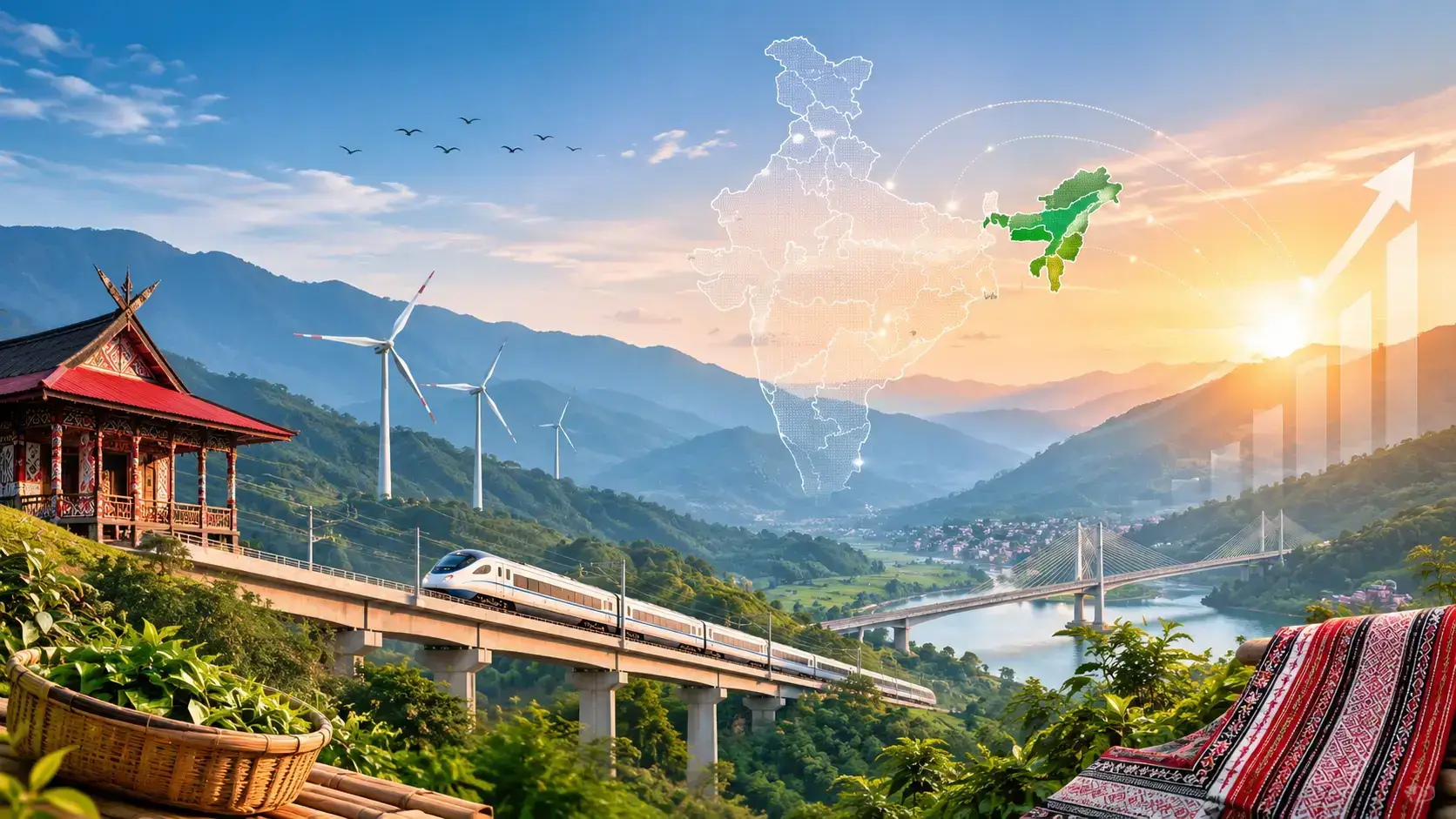
Northeast India is now stepping up as a vibrant, strong, attractive new destination for investors. Investment in Northeast India has gained momentum over the last twelve years, a mix of smart policies, direct support programs, and a massive push to build better infrastructure including industrial parks, airports, national highways, roads, bridges has sparked this change. We are already seeing the results as serious money begins to flow into the region.
The profile and attractiveness of these eight states grew significantly when Honourable Prime Minister Shri Narendra Modi named the region as India’s "Ashtalakshmi." The journey to make Northeast a top investment destination kicked off in 2014 with a major shift in focus and direction. In November 2014, the "Look East Policy" became the "Act East Policy," putting the region at the forefront of national agenda, no more just looking, time to act. This change pivoted NE into India’s main gateway to Southeast Asia. Not only is this boosting the NE economy, but also helping build strategic, stronger friendships and cultural links with neighbouring countries.
Some of its Key Features are:
- Wider Regional Reach: The policy broadens its horizon beyond Southeast Asia to include major Pacific powers. By deepening ties with Japan, South Korea, Australia, and New Zealand, India is building a more comprehensive network of partnerships across the East.
- Core Pillars of Action: The mission is built on the 4Cs framework, which prioritizes Culture, Commerce, Connectivity, and Capacity Building. This multi-layered approach ensures that economic growth is supported by strong social and physical links.
- Defense and Maritime Security: A major focus is placed on keeping the Indo-Pacific region safe and open for all. Through joint military drills and maritime cooperation, the policy works to protect essential trade routes and ensure freedom of navigation.
- Developing the Northeast Gateway: This strategy places Northeast India at the center as the gateway to Southeast Asia. By upgrading local infrastructure, the region is being transformed into a hub for international trade and cross-border movement.
- Transformative Infrastructure: The push for connectivity is led by massive projects like the India-Myanmar-Thailand Trilateral Highway and the Kaladan Multi-Modal Transit Transport Project, which are set to redefine how goods move across borders.
Today Northeast is being seen as a united economic power that connects India to its neighbours. Thanks to the "Act East" push, investment in Northeast India is gaining momentum as the region is no longer a landlocked frontier but a bridge that links Indian businesses with the fast-growing economies of Southeast and East Asia.
Major upgrades to local transport like fixing up waterways, roadways, strategic location of ports along West Bengal have cleared up old trade delays. Northeast’s huge potential in clean energy, oil and gas, and organic farming is making the region a top choice for businesses looking to grow strategically.
The combined energy and potential of these eight states are captured in the name "Ashtalakshmi," which refers to the eight forms of wealth and prosperity. This vision treats the Northeast as one united economic force rather than a group of isolated states. Each state brings its own special strengths to the table, creating a powerful team. By using their rich natural resources and building better linkages across borders, they are connecting with the rest of the world. This unity has made the region the engine behind India’s "Act East" policy, bringing in new wealth and business opportunities for everyone.
Infrastructure: The Core Backbone of Regional Connectivity
Modern Transport Hubs
The new facility Multi Modal Logistics Park at Jogighopa, Assam is a high-tech center that connects local factories directly to world trade routes. By bringing together rail, road, and water pathways, this hub helps get rid of delays and makes shipping much faster. It gives forward-thinking companies a quick and easy way to send their products abroad.
Better Waterways
By using the Brahmaputra and Barak rivers for trade, businesses get a cheap and reliable way to reach international shipping ports. These water routes connect directly with major ocean hubs nearby, letting heavy shipments skip crowded roads. This change cuts shipping costs, boosts trade, and makes the Northeast a fast-track gateway to the global market.
Strategic River Ports and "Ports of Call" are being established as essential transshipment points, allowing heavy cargo to transition smoothly onto river vessels:
- Brahmaputra River Network (NW-2): Key nodes include Pandu (Guwahati), Jogighopa, Dhubri, Silghat, Neamati, and Dibrugarh.
- Barak River Network (NW-16): Primary centers feature Karimganj, Badarpur, and Silchar.
- Strategic Links in Bangladesh: Cooperation extends to Ashuganj, Narayanganj, Khulna, Sirajganj, and Bahadurabad.
- Direct Waterway Links for Assam: The state benefits from integrated access across both major river systems. While the Brahmaputra spans its entire territory, the Barak Valley serves as a vital southern logistics corridor.
Faster Rail Growth
Rail funding has jumped, with the budget for the region increasing five times over the last ten years. Funds have helped build better tracks and connect capital cities to the rest of the country. Since 2014, rail travel has seen a huge boost; new sections are being finished nearly three times faster than before. Plus, more than 44,000 kilometers of track were electrified between 2014 and 2025, more than doubling what was done in the previous sixty years.
1. Expansion of the Rail Network:
- Connecting Manipur (Jiribam–Imphal): This ambitious 110.63 km project navigates difficult terrain to link Imphal with the rest of the country. A standout feature is the Noney Bridge, which will be among the world's tallest pier bridges once finished.
- Reaching Nagaland (Dimapur–Kohima): A 78.42 km expansion is carving a path through the hills to bring rail access to Zubza. Progress is already visible, with trains now running through the active Shokhuvi and Molvom stations.
- Sikkim’s First Tracks (Sivok–Rangpo): This 45 km strategic link connects West Bengal to Sikkim, establishing the state's very first footprint on the national railway map.
- Cross-Border Trade (Kokrajhar–Gelephu): Linking Assam to Gelephu in Bhutan, this international line is designed to speed up regional commerce and provide a direct path to the Jogighopa Multi-Modal hub.
2. Modernizing the Gateway Stations:
Through the Amrit Bharat initiative, local transit points are being turned into high-tech hubs that feel like airports, blending modern comfort with beautiful local designs:
- New Landmarks for Capitals: Major new facilities like Sairang (Mizoram), Zubza (Nagaland), and Imphal Station (Manipur) are being built as grand gateways that celebrate local culture.
- Upgrading Assam’s Hubs: Massive work is nearly done at vital spots like Majbat (98%), Viswanath Chariali (97%), and Fakiragram (88%), while Chaparmukh and Haibargaon follow closely behind.
Air Travel Boom
Thanks to the UDAN program, air travel in the Northeast has taken off, with over 90 new routes making the region much easier to reach. In just five years, the number of working airports grew from 7 to 19.
The 19 Operational Airports of Northeast India
| # | Airport | Location | State | Notes |
| 1 | Lokpriya Gopinath Bordoloi International Airport (Guwahati) | Guwahati | Assam | Primary international gateway to NE India |
| 2 | Dibrugarh Airport | Mohanbari | Assam | |
| 3 | Silchar Airport | Kumbhirgram | Assam | |
| 4 | Jorhat Airport | Rowriah | Assam | |
| 5 | Tezpur Airport | Salonibari | Assam | |
| 6 | Lilabari Airport | North Lakhimpur | Assam | |
| 7 | Rupsi Airport | Dhubri/Kokrajhar | Assam | UDAN revival of WWII airstrip; serves Assam-Bhutan trade corridor |
| 8 | Donyi Polo Airport | Hollongi, Itanagar | Arunachal Pradesh | State's premier greenfield capital airport |
| 9 | Pasighat Airport | Pasighat | Arunachal Pradesh | |
| 10 | Tezu Airport | Tezu | Arunachal Pradesh | |
| 11 | Ziro Airport | Ziro | Arunachal Pradesh | Advanced landing ground repurposed for commercial use |
| 12 | Maharaja Bir Bikram Airport | Agartala | Tripura | Region's 2nd busiest terminal |
| 13 | Bir Tikendrajit International Airport | Imphal | Manipur | |
| 14 | Dimapur Airport | Dimapur | Nagaland | |
| 15 | Shillong Airport | Umroi | Meghalaya | |
| 16 | Lengpui Airport | Aizawl | Mizoram | |
| 17 | Pakyong Airport | Gangtok | Sikkim | Notable hill-engineering feat |
| 18 | Chabua Air Force Station | Chabua | Assam | Dual-use military/civil transit |
| 19 | Jorhat Air Force Station | Rowriah | Assam | Shared military-commercial hub |
This expansive aviation network spans across all eight states, providing high-capacity, broad-spectrum air access to formerly isolated hill geographies. By bridging the distance, these hubs are opening up new commercial horizons:
Drastically reduced travel times are allowing enterprises to streamline administrative oversight and transport premium inventory with ease. By linking the most remote corners, this aviation surge ensures that every business center is fully integrated into the global economy.
Commercial Impact: Real-World Aviation Success
The proliferation of active flight paths has revolutionized standard operations for regional commerce and international trade networks:
- High-Speed Fresh Produce Pipeline: Under the Krishi UDAN model, perishable organic treasures like large cardamom from Sikkim, Lakadong turmeric from Meghalaya, and Queen Pineapples from Tripura no longer perish on winding roads. Direct air cargo from Agartala and Pakyong delivers these goods to luxury international markets within a day, significantly augmenting farmer profits.
- Efficient Corporate Management: Previously, a 12-hour overland trek was required to reach sites in Arunachal Pradesh from Guwahati. Today, UDAN flights connect these locations in under an hour, allowing auditors and technicians to complete site visits and return within the same business day.
- Secured Logistics for High-Value Goods: Industries dealing in specialized machinery or biological serums now utilize regional hubs in Lilabari and Dibrugarh. This allows them to completely bypass landslide-prone zones on critical national highways, ensuring a steady flow of high-value freight.
Strategic Sectors for Investment
If you’re an entrepreneur looking for a place with room to grow, look to the East. Beyond the beautiful views, Northeast India is becoming a real economic engine and a great place to expand your business. With new roads, business-friendly leaders, and a tech-savvy population, the region is ready for new ventures. For early investors, there are four main areas that are ready for growth right now:
The Clean Energy Opportunity
The Northeast is becoming India’s hub for clean energy. Large projects like the ₹30,000+ crore Dibang Project and the Lower Subansiri Hydroelectric Project in Assam are changing the game. For green-tech businesses, there is plenty of room to build solar grids and new biomass systems in the river valleys.
Farming and Food Processing
The region is moving away from just selling raw crops to building well-known brands. Assam already has over 850 tea estates and lots of rubber farming. But the real chance for success is in organic food. Startups that can help with cold storage, better packaging for international sales, or branding local superfoods like organic ginger and spices are in a great position. These companies also benefit from government support designed to help modernize farming in the region.
Promoting Regional Superfoods and Spices:
Local ventures are expanding the region's agricultural reach by branding and delivering unique products to high-end domestic and global markets:
- Zizira (Meghalaya): Based in Shillong, this digital processor sources Lakadong Turmeric, forest honey, and organic ginger. Growth is driven by transparent supply chains, quality checks, and sustainable packaging.
- The Organic Carbon (Assam): This startup exports regional specialties globally, processing Bhut Jolokia and organic ginger into high-value infused products and powders.
- NE Origins (Regional): A unified marketplace connecting smallholders across eight states, providing standardized branding for delicacies like Naga Mircha, black rice, and green teas.
- Elrhino (Assam): Produces hand-rolled luxury teas with zero-waste packaging made from animal dung, supporting environmental conservation.
Local and Cultural Tourism
Today’s travelers want real experiences, not just fancy hotels. With hundreds of tribes and unique cultures, the Northeast is perfect for this. To make the most of it, we need more eco-resorts and apps that help tourists explore these cultures respectfully. Big names like Reliance Industries are already starting to invest in hotels here.
The Luxury Surge: Corporate Brands Enter the Market
Prominent hospitality leaders are committing significant resources to redefine the area as a high-end travel hub, demonstrating a profound belief in the region's tourism potential:
- The Taj Group (IHCL Growth): Moving to solidify its presence, IHCL has finalized a landmark deal to introduce the 250-room Taj Guwahati, anchoring its growing footprint in Assam. The group is further penetrating the Northeast with projects like the Taj Pushpabanta Palace in Tripura, premium Sikkimese villas, a high-end Kaziranga safari base, and the newly announced Gateway Dirang in Arunachal Pradesh.
- Courtyard by Marriott (Shillong): This modern, upscale venue serves as a sophisticated gateway for global visitors exploring the Meghalayan hills and its rich local traditions.
- Ambuja Neotia Collaboration: Working alongside IHCL, this partnership aims to bring 15 world-class hotels to the region, establishing a new standard of luxury across formerly remote landscapes.
Tech and High-End Manufacturing
In an impressive move, the region is going straight to high-tech manufacturing. Assam is joining the global tech scene with Tata’s massive ₹27,000 crore semiconductor plant. This big project is creating a new environment for smaller tech startups to grow alongside it.
This push is led by major companies that are setting up large operations, which in turn creates more work for smaller, faster startups. By building these high-tech hubs, anchor investments, the region is creating a strong and independent business world that will bring long-term stability and wealth to the area.
The Act East Paradigm: India’s Doorstep to the ASEAN & BBIN Markets
Initiated in 2014, India’s Act East Policy has fundamentally reshaped Northeast India, converting a once-landlocked frontier into a thriving sub-regional logistics hub. Today, the region serves as a crucial economic gateway linking India to the ASEAN and BBIN (Bangladesh, Bhutan, India, Nepal) markets. It is the front door to a market of over 600 million customers in Southeast Asia and the neighboring countries of Bangladesh, Bhutan, and Nepal.
Anchored by the "4 C's" framework (Culture, Commerce, Connectivity, and Capacity Building), this roadmap realigns the nation's financial priorities toward its eastern borders. The mission seeks to forge stable commercial pathways, unify regional energy grids, and offer a firm strategic geopolitical positioning.
The Infrastructure Architecture: "Panchapath"
To realize the "Act East" mission, the government has launched the ambitious "Panchapath" architecture, a five-pronged development strategy targeting Highways, Rail Networks, Aviation, Riverine Routes, and Digital Connectivity. These high-impact initiatives bypass the strategic bottleneck of the Siliguri Corridor, establishing robust and efficient corridors for international commerce via terrestrial and maritime pathways.
Path 1: Highways (Terrestrial Trade Corridors)
Establishing high-capacity, all-weather road networks directly links the region with Myanmar, Thailand, and Bhutan, ensuring fluid trade regardless of seasonal conditions.
- India-Myanmar-Thailand (IMT) Trilateral Highway: A 1,360 km cross-border route connecting Moreh (Manipur) to Mae Sot (Thailand), serving as the main terrestrial artery into Southeast Asian hubs.
- Strategic Frontier Highways: Projects like the Arunachal Frontier Highway redefine boundary logistics, connecting remote zones with economic centers to boost security and trade.
- Bharatmala Pariyojana Expansion: Upgrading over 5,000 km of roads to 4-lane standards seamlessly connects local manufacturing units to international transit points.
Path 2: Rail Networks (Capital & Trans-National links)
This initiative connects hill capitals to the national broad-gauge network and creates new international rail links to simplify bulk cross-border freight.
- Jiribam–Imphal Strategic Line: A 111 km technical feat featuring the Noney Bridge. It will eventually reach Moreh, integrating India's rail system with Myanmar's network.
- Sivok–Rangpo Corridor: A 45 km mountain line utilizing advanced tunneling to bring Sikkim onto the national railway map, unlocking commercial opportunities.
- Kokrajhar–Gelephu International Link: India’s first rail link to Bhutan connects Assam to Gelephu Mindful City, facilitating faster industrial exchange.
Path 3: Aviation (The Regional Air Capital Network)
Driven by the UDAN initiative, the region's aviation footprint has expanded nearly threefold, accelerating executive travel and premium cargo delivery.
- Donyi Polo Greenfield Airport: Arunachal Pradesh’s premier capital aviation hub ensures year-round accessibility for global investors.
- Rupsi Trade Hub: Reviving this historic airstrip under UDAN provides a vital logistics gateway for lower Assam and the Bhutanese border.
- Krishi UDAN 2.0 Logistics: Dedicated air-cargo stations at Guwahati and Agartala allow organic items like Lakadong turmeric to bypass road transit and reach international buyers fresh.
Path 4: Riverine Routes (Maritime & Inland Waterways)
Leveraging the Brahmaputra and Barak river systems reconnects the Northeast with the Bay of Bengal, cutting freight expenses by up to 70%.
- Indo-Bangladesh Protocol (IBP) Access: Permits regional cargo to flow directly through Bangladesh to deep-sea hubs at Chattogram and Mongla for global export.
- Kaladan Multi-Modal Project: Connects Kolkata to Myanmar’s Sittwe Port by sea, routing cargo inland to Mizoram and avoiding the Siliguri bottleneck.
- Jogighopa Multi-Modal Park: A 317-acre high-tech hub integrating road, rail, and water transport to process international freight heading toward Bhutan and Bangladesh.
Path 5: Digital Connectivity (High-Speed International Fiber Trunks)
Building a robust digital backbone ensures low-latency tracking and seamless financial clearances for global trade partners.
- Agartala International Gateway: Tapping submarine cables from Cox's Bazar makes Agartala India’s third major internet entry point, ensuring world-class digital connectivity.
- Telecom Development Plan (CTDP): Widespread 4G/5G infrastructure across border valleys supports smart logistics and automated supply chains landscape-wide.
Economic Impact: Markets in Numbers
The shift from diplomatic discussions to concrete infrastructure projects has catalyzed an unprecedented boom in sub-regional economic activity:
- Surge in Trade Volumes: Bilateral commerce between India and ASEAN witnessed a dramatic expansion, climbing from $65 billion in 2015 to over $123 billion by 2025/2026.
- Inflow of Foreign Capital: Led primarily by substantial investments from Singapore, cumulative FDI from ASEAN into India surpassed $117 billion.
- Managing Trade: Current policy updates focus on accelerating services exports in IT, fintech, and education, alongside reviewing the 2009 ASEAN-India Free Trade Agreement (AFTA).
Critical Comparison Takeaways
- A New Perspective on Distance: As you move east across the region, you realize how close it is to international neighbors. For example, Aizawl is only 561 km from Naypyidaw in Myanmar and 1,378 km from Bangkok, but it’s more than 1,750 km away from New Delhi.
- Naturally Connected to Southeast Asia: Eastern cities are surprisingly close to their neighbors. Both Imphal (1,288 km) and Aizawl (1,380 km) are much closer to the industrial city of Hanoi than to Mumbai, which is over 2,300 km away.
- The Gateway City: As the center of the region, Guwahati sits in a perfect middle spot. It is almost the same distance to Delhi (1,460 km) as it is to Bangkok (1,653 km).
India’s Northeast (NE) region acts as the strategic land and multimodal gateway to Southeast Asia (SEA) under India’s Act East Policy. As cross-border infrastructure expands via projects like the India-Myanmar-Thailand Trilateral Highway and integration through Bangladesh's Chattogram port, Indian companies especially those leveraging the NE can tap into high-growth addressable sector markets across SEA. The region has significant potential to connect Indian businesses to the ASEAN market. ASEAN has a population of around 690 million and a combined GDP exceeding US$4 trillion, making it one of the world's fastest-growing economic regions.
Using Hanoi (Northern Vietnam) as a prime case study, the city serves as a major manufacturing and economic hub for regional electronics and automotive clusters. Vietnam imports over 80% of its industrial raw materials, giving Indian supply chains a massive addressable footprint as bilateral trade targets aim for $25 billion.
Key Addressable Sectors in SEA (Hanoi) for Indian & NE Businesses
Hanoi and its surrounding northern industrial zones (like Bac Ninh and Hai Phong) specialize heavily in high-value tech, automotive, and electronics assembly. Indian firms can target several lucrative sub-sectors:
1. Electronics & Automotive Component Supply Chains
- The Market Opportunity: Hanoi is a massive global assembly hub for consumer electronics (Samsung) and electric vehicles/automotive lines (VinFast, Honda).
- The India/NE Play: Indian component manufacturers can plug in as Tier-2 and Tier-3 suppliers. Vietnam requires consistent, massive upstream imports of engineering components, plastics, metal castings, and embedded systems.
2. IT, Digital Services, and KPO/BPO Hubs
- The Market Opportunity: Northern Vietnam is undergoing a massive digital transformation, creating a high demand for enterprise software, cybersecurity, cloud architecture, and SaaS.
- The India/NE Play: India's tech sector can supply the underlying digital payment architectures and fintech solutions. Additionally, with major tech developments in the NE including the National Data Centre (NEDC) and hyperscale data centers in Assam the NE is equipped to offer competitive, English-speaking Knowledge Process Outsourcing (KPO) and IT-enabled services (ITeS) to the SEA market.
3. Smart Agriculture and High-Value Food Processing
- The Market Opportunity: Vietnam’s northern provinces are rapidly modernizing their agricultural supply chains, creating an addressable market for automated farm machinery, agritech, and sustainable agricultural inputs.
- The India/NE Play: The NE is an organic agricultural powerhouse. Businesses can export raw and value-added agricultural inputs, processed organic foods, specialty tea, and spices directly into Hanoi's expanding consumer markets.
4. Pharmaceuticals and MedTech
- The Market Opportunity: Hanoi is the primary distribution node for healthcare products in North Vietnam. The government is actively digitizing its healthcare network and seeking affordable, high-quality medical supplies.
- The India/NE Play: India is a global pharmaceutical hub. While bulk active pharmaceutical ingredients (APIs) usually enter via southern ports, Hanoi provides a massive market for Indian generic medicines, diagnostic medical devices, and digital healthcare/telemedicine platforms.
Strategic Edge: Shifting Logistics from Land to Sea
| Trade Route | Operational Realities & Market Access |
| Traditional Land Routes | Routes like the Pangsau Pass (Arunachal Pradesh to Myanmar) and the Moreh-Tamu border (Manipur) are highly strategic but face ongoing regional instability in Myanmar. Trade here remains centered on local border haats. |
| Emerging Multimodal Sea Routes | For heavy industrial trade to Hanoi, NE companies are increasingly routing goods south through Bangladesh (via the Agartala-Akhaura rail link) to the Chattogram Port. |
Investment Momentum: The Data
India as a whole is seeing record-breaking investment and Northeast is supporting the speed.
Japan is leading the way here. The Japan Bank for International Cooperation and Sumitomo Mitsui are funding a huge $408 million project to turn bamboo into fuel in Assam. This is Japan’s biggest business commitment in the region so far, and it makes great use of local resources.
Finnish companies like Fortum and Chempolis are also part of this project, bringing in new technology. This plan will involve around 30,000 local farmers, bringing new life to a market that had slowed down after old paper mills closed.
This project is a great example of how global tech and money can help local communities grow. On top of this, Japan has provided over $2 billion for building roads through JICA. This kind of support shows how important the region is to international plans like the "Act East" policy.
The numbers show a clear change: more money is pouring into the Northeast than ever before, turning it into a new financial hotspot.
Conclusion: NER as self-sufficient economic unit contributing to Viksit Bharat
The Northeast is going through a massive change. By focusing on clean energy, organic farming, and high-tech manufacturing, the region is building its own future. This shift is bringing long-term stability, new wealth, and a place on the world stage.
This transformation is a key part of India’s overall growth. A strong and united Northeast acts as a bridge between India and the fast-growing economies of Southeast Asia. By improving river routes, trains, and flights, the region has cleared the path for trade. With new infrastructure and big investments, the Northeast is now an essential part of India’s economic future and its connection to the rest of the world.
Annexure : Distance from Northeast State Capitals to Major Southeast Asian Capitals (km)
| NE Capital (State) | Naypyidaw (Myanmar) |
Hanoi (Vietnam) |
Bangkok (Thailand) |
Kuala Lumpur (Malaysia) |
Singapore (Singapore) |
Manila (Philippines) |
Jakarta (Indonesia) |
| Aizawl (Mizoram) | 561 | 1,380 | 1,378 | 2,484 | 2,761 | 3,130 | 3,663 |
| Imphal (Manipur) | 604 | 1,288 | 1,410 | 2,550 | 2,817 | 3,042 | 3,720 |
| Agartala (Tripura) | 671 | 1,527 | 1,481 | 2,558 | 2,841 | 3,275 | 3,741 |
| Kohima (Nagaland) | 687 | 1,301 | 1,483 | 2,633 | 2,897 | 3,054 | 3,800 |
| Shillong (Meghalaya) | 776 | 1,510 | 1,593 | 2,706 | 2,982 | 3,265 | 3,884 |
| Guwahati (Assam) | 837 | 1,544 | 1,653 | 2,769 | 3,045 | 3,298 | 3,947 |
| Itanagar (Arunachal Pradesh) | 852 | 1,410 | 1,646 | 2,797 | 3,061 | 3,154 | 3,964 |
| Gangtok (Sikkim) | 1,134 | 1,880 | 1,950 | 3,028 | 3,313 | 3,632 | 421 |
This blog is written by Niharika Das