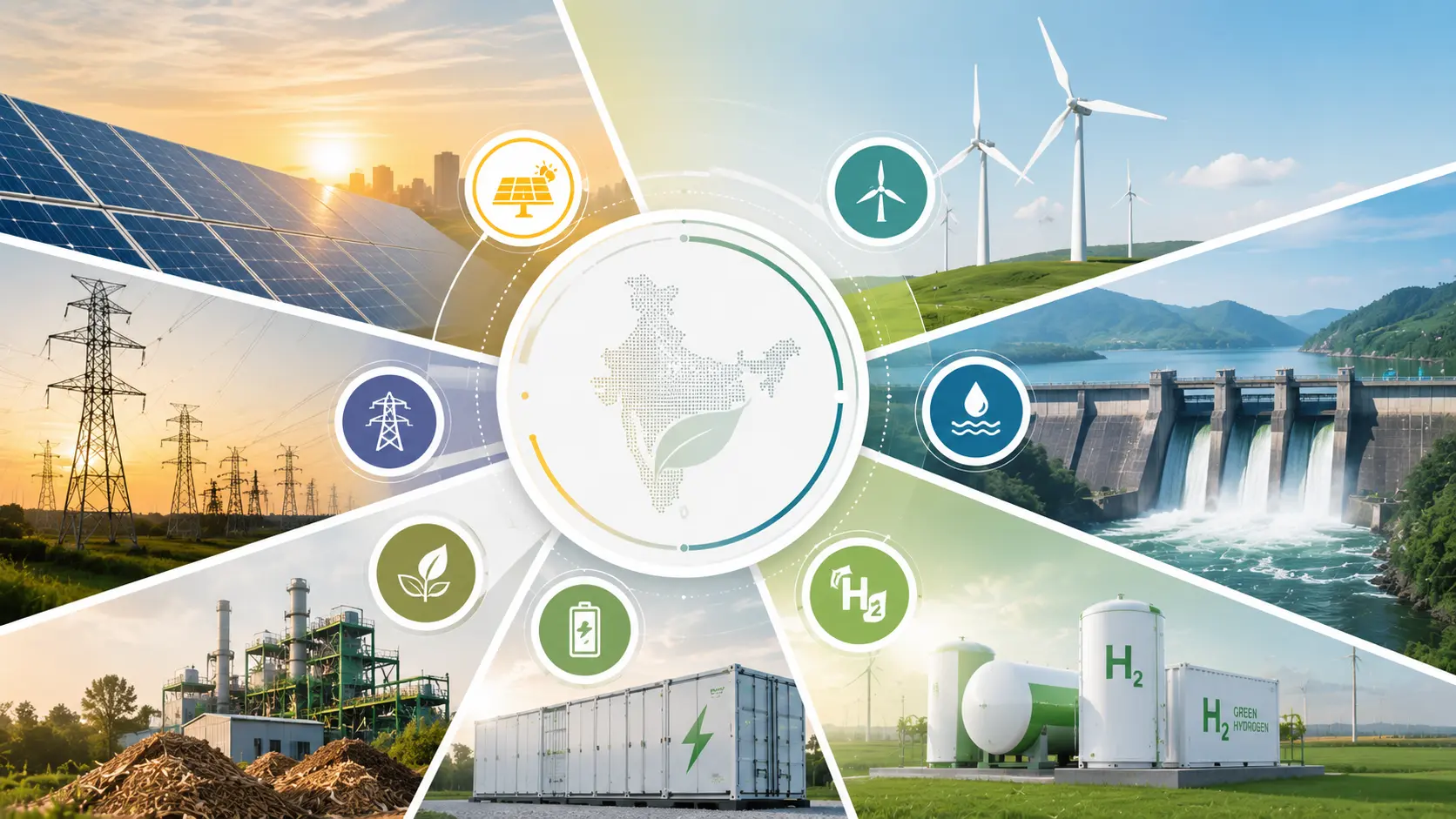
India’s clean energy sector has emerged as one of the world’s largest long-term investment opportunities. The country has been building an integrated clean energy ecosystem spanning renewable power generation, transmission, energy storage, manufacturing, and next-generation fuels. For investors, this clean energy story extends beyond renewable energy power generation. It reflects the convergence of multiple structural trends, such as rapid economic growth, industrial expansion, energy security, technological innovation, and the global transition towards low-carbon development.
As of 30th June 2026, the country has an installed renewable energy capacity of 288.58 GW, comprising 162.15 GW of solar power, 57.44 GW of wind power, 57.24 GW of large hydropower, and 11.75 GW of bioenergy. Including nuclear power, India’s total non-fossil fuel-based installed electricity capacity stood at 297.36 GW, reflecting steady progress towards a cleaner and more diversified energy mix. This sheer scale has positioned the country among the world’s leading renewable energy markets, providing a strong foundation for continued investment across power generation, manufacturing, transmission infrastructure, energy storage, and emerging clean energy technologies.
Beyond expanding renewable electricity generation, the country is also strengthening domestic manufacturing, modernising electricity networks, promoting green hydrogen, expanding energy storage, and encouraging innovation across clean technologies. Together, these developments are transforming India's clean energy sector into a diversified investment ecosystem capable of supporting sustainable economic growth while contributing to global decarbonisation.
India’s Clean Energy Sector: Powering the Next Phase of Economic Growth
The country’s expanding energy needs closely support its economic growth. As industrial production, urbanisation and digitalisation continue to accelerate, the country will see electricity demand rise substantially over the coming decades. Meeting this demand sustainably has become a national priority, positioning the Clean Energy Sector at the centre of India's long-term development strategy.
Over the last decade, India has significantly diversified its energy mix by rapidly expanding renewable energy capacity across solar, wind, bioenergy and small hydro. According to the Ministry of New and Renewable Energy (MNRE), India has emerged as a global leader in renewable energy deployment, supported by sustained policy interventions and competitive market mechanisms.
Large-scale investments in transmission infrastructure, battery storage, green mobility and domestic manufacturing also support this transformation. Together, these developments are creating an integrated ecosystem capable of supporting India's ambitions of becoming a global clean energy hub.
Why India’s Renewable Energy Market Is Attracting Global Investors
India's renewable energy market has witnessed remarkable growth, supported by transparent policy frameworks, competitive bidding mechanisms and sustained government commitment. Today, renewable energy contributes a significant share of the country's installed power capacity, with solar energy emerging as the primary growth driver.
Large-scale solar parks, rooftop solar programmes and wind energy projects continue to attract domestic and international investment. Government initiatives have also expanded opportunities across floating solar, offshore wind, hybrid renewable projects and distributed renewable energy systems.
Beyond electricity generation, India is developing an entire renewable energy value chain. Rising industrialisation, electric mobility, data centres and urban infrastructure are expected to significantly increase power consumption over the coming years. Renewable energy is expected to play a central role in meeting this demand while supporting India's climate commitments.
Government Policies Driving India's Clean Energy Transition
Over the past decade, the Indian government has introduced a series of reforms and flagship programmes aimed at accelerating clean energy deployment while creating a favourable investment climate.
- The National Green Hydrogen Mission represents one of India's most ambitious clean energy initiatives. By supporting the production, utilisation and export of green hydrogen, the Mission aims to establish India as a global hub for the production, consumption and export of green hydrogen and its derivatives.
- Similarly, the PM Surya Ghar: Muft Bijli Yojana is expanding rooftop solar adoption across millions of households while strengthening distributed renewable energy generation.
- The government has also strengthened policy support through Renewable Purchase Obligations (RPOs), Green Energy Open Access Rules, and waiver of Inter-State Transmission System (ISTS) charges for eligible renewable energy projects. Together, these initiatives have improved ease of doing business and reduced project development risks.
- Through Production Linked Incentive (PLI) schemes, India is encouraging domestic manufacturing of high-efficiency solar PV modules and advanced clean energy technologies. This aligns with the broader objectives of Make in India and Atmanirbhar Bharat, while reducing import dependence and strengthening domestic supply chains.
The consistency of these reforms provides long-term policy visibility, enabling businesses to make investment decisions with greater confidence.
Solar, Wind and Green Hydrogen: Expanding Investment Opportunities
The country’s clean energy transition is creating investment opportunities across multiple renewable technologies, each supported by dedicated policy frameworks and growing market demand.
-
Solar energy continues to lead capacity additions, driven by utility-scale projects, rooftop installations and government-backed solar parks. Competitive tariffs, falling technology costs and supportive policies have positioned solar power as one of the country's most attractive infrastructure investment opportunities.
-
Wind energy also remains a critical component of India's renewable energy mix. The government is encouraging both onshore and offshore wind development to diversify renewable generation and strengthen grid stability.
-
Green hydrogen has emerged as the next frontier of India's clean energy ambitions. The National Green Hydrogen Mission seeks to promote large-scale production of green hydrogen for domestic consumption as well as exports.
Rather than focusing on a single technology, the country’s clean energy strategy promotes a diversified ecosystem.
Manufacturing Growth and the Make in India Advantage
Beyond renewable power generation, a robust domestic manufacturing ecosystem is increasingly driving this transition by strengthening supply chains, reducing import dependence and creating new opportunities for global investors.
Under the Make in India initiative, the Government has introduced several measures to encourage domestic manufacturing of renewable energy equipment. The Production Linked Incentive (PLI) Scheme for High Efficiency Solar PV Modules has attracted significant investments across the solar value chain, from polysilicon and wafers to cells and modules. The government is also supporting domestic manufacturing of advanced battery technologies, electrolysers for green hydrogen production and other clean energy equipment.
The expanding renewable energy market provides manufacturers with a unique advantage. For global manufacturers seeking to diversify supply chains, India offers a strategic location, competitive operating costs and a growing domestic market, making it an attractive destination for long-term investment.
Grid Modernisation, Energy Storage and Green Infrastructure
A successful clean energy transition requires more than renewable power generation. It depends equally on modern transmission infrastructure, energy storage systems and digital grid technologies capable of managing increasing shares of renewable electricity. Recognising this, the Government of India has significantly expanded investments in transmission infrastructure through initiatives such as the Green Energy Corridors programme.
Battery Energy Storage Systems (BESS) have emerged as another critical area of investment. As renewable energy generation increases, energy storage will play a vital role in maintaining grid stability, balancing supply and demand and improving overall system reliability. Pumped storage projects are also gaining momentum as an efficient long-duration energy storage solution. Alongside physical infrastructure, India is rapidly modernising its power sector through digital technologies, including smart meters, advanced forecasting systems and digital grid management solutions.
Together, investments in transmission, storage and grid modernisation are creating an enabling environment for renewable energy growth while opening new avenues for private sector participation across the energy value chain.
Why Businesses Should Invest in Green Energy in India
The country’s clean energy ecosystem presents a compelling investment proposition built on long-term structural fundamentals rather than short-term market cycles.
First, the country’s rapidly growing economy continues to drive sustained increases in electricity demand. Rising industrialisation, expanding urban infrastructure, digitalisation and the adoption of electric mobility are expected to increase energy consumption over the coming decades significantly. Renewable energy will play a central role in meeting this demand sustainably.
Secondly, policy continuity has strengthened investor confidence. Successive government initiatives, including renewable energy targets, manufacturing incentives, green hydrogen development and transmission infrastructure expansion, demonstrate a long-term commitment to the sector.
And third, the scale here creates opportunities across multiple investment segments. Businesses can participate in utility-scale renewable projects, distributed energy systems, equipment manufacturing, engineering services, battery storage, green hydrogen production and clean technology innovation. This diversified ecosystem allows investors to align opportunities with their expertise and long-term business strategies.
For organisations investing in sustainable energy, India offers an ecosystem supported by policy certainty, expanding infrastructure, technological innovation and one of the world's largest energy markets.
The Future of India's Clean Energy Sector
India’s clean energy ambitions extend well beyond expanding renewable capacity. The country is laying the foundation for a comprehensive low-carbon economy driven by innovation, manufacturing, digital infrastructure and sustainable industrial growth.
The government’s target of achieving 500 GW of non-fossil-fuel-based installed electricity capacity by 2030 is among the world's most ambitious energy transition programmes. Continued investments in research, innovation and domestic manufacturing will further strengthen India's competitiveness in global clean energy markets.
The country’s demographic advantage, skilled workforce, rapidly expanding industrial base and supportive policy framework position it to become not only one of the world's largest renewable energy markets but also a leading producer of clean energy technologies.
As global businesses increasingly diversify supply chains and pursue sustainability goals, India's integrated clean energy ecosystem provides a compelling platform for long-term growth, innovation and collaboration.
Sources:
-
Ministry of New and Renewable Energy. Renewable Energy Installed Capacity and Physical Progress Reports. MNRE. - mnre.gov.in/en/physical-progress/
-
Press Information Bureau. India Achieves 50% of Installed Electricity Capacity from Non-Fossil Fuel Sources. Government of India. - pib.gov.in/PressReleasePage.aspx?PRID=2183866
-
Ministry of New and Renewable Energy. National Green Hydrogen Mission. Government of India. - mnre.gov.in/en/national-green-hydrogen-mission/
-
Press Information Bureau. Union Cabinet Approves National Green Hydrogen Mission. Government of India. - pib.gov.in/PressReleasePage.aspx?PRID=1896592
-
Ministry of New and Renewable Energy. PM Surya Ghar: Muft Bijli Yojana. Government of India. - mnre.gov.in/en/notice/guidelines-for-pm-surya-ghar-muft-bijli-yojana/
-
Ministry of Power. Green Energy Corridors Programme. Government of India. - mnre.gov.in/en/notice/guidelines-for-pm-surya-ghar-muft-bijli-yojana/
-
Ministry of Power. Green Energy Open Access Rules, 2022. Government of India. - mnre.gov.in/en/centre-rules/
-
Ministry of New and Renewable Energy. Production Linked Incentive (PLI) Scheme for High Efficiency Solar PV Modules. Government of India. - mnre.gov.in/en/policies-and-regulations/schemes-and-guidelines/schemes/
-
Central Electricity Authority. National Electricity Plan. Government of India. - cea.nic.in/
-
Ministry of Power. Renewable Purchase Obligation (RPO) Trajectory. Government of India. - www.recregistryindia.nic.in/pdf/REC_Regulation/Renewable_Purchase_Obligation_and_Energy_Storage_Obligation_Trajectory_till_2029_30.pdf