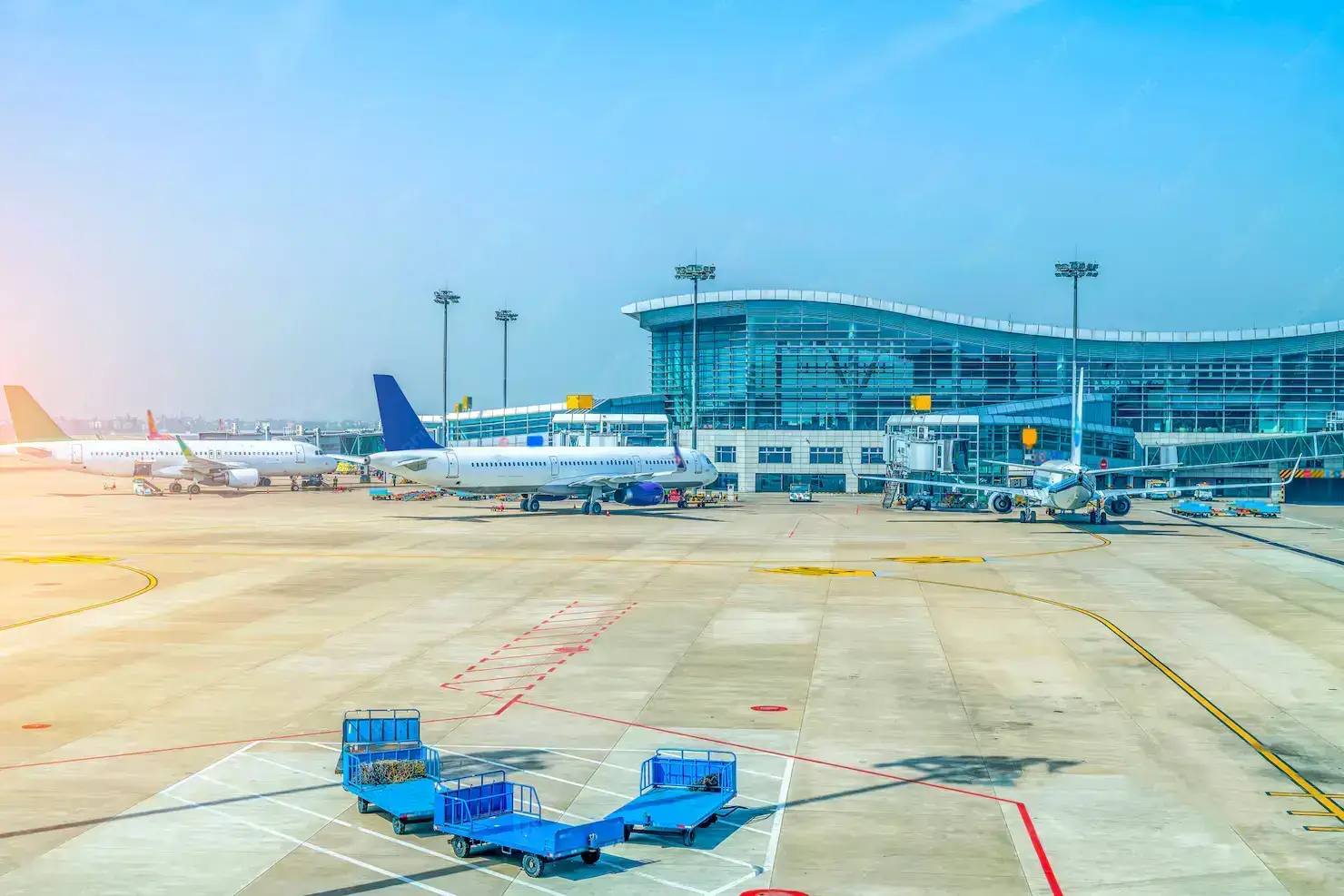
India's civil aviation sector is undergoing a significant transformation, supported by rising passenger demand, expanding airport infrastructure, stronger regional connectivity and a rapidly growing airline fleet. The country's aviation ecosystem is also widening beyond passenger travel, with developments in aircraft leasing, maintenance, repair and overhaul (MRO), pilot training, cargo and aerospace manufacturing.
India has emerged as the world's third-largest domestic aviation market, with Indian airports handling more than five lakh passengers every day.[1]
As the foundations strengthen, the growth of aviation sector in India is increasingly being shaped by both domestic demand and the development of a broader aviation ecosystem.
Quick Takeaways
- India is the world's third-largest domestic aviation market.[1]
- By 2026, there will be 165 operational airports, up from 74 in 2014.[2]
- Indian carriers currently have 1,640 aircraft on outstanding order.[3]
- UDAN has expanded regional air connectivity by linking underserved and unserved destinations.[4]
- Government measures are strengthening aircraft leasing, MRO, pilot training and aviation manufacturing.
- 100% FDI is permitted through the automatic route for MRO, and scheduled airlines can receive FDI of up to 100%.[8][11]
Passenger growth, infrastructure expansion and fleet additions are supporting the long-term development of the Indian aviation industry.
Rising Passenger Demand Is Driving Aviation Growth
Passenger demand remains one of the strongest foundations of the Indian aviation market. More people are travelling by air for business, tourism, education and personal mobility, while expanding connectivity is bringing air travel to a wider section of the country.
Indian airports now handle more than five lakh passengers every day. The Government has noted that this reflects the rapid growth of the sector.[1]
This increase in demand is encouraging airlines to expand capacity and strengthen domestic and international networks. The resulting demand extends beyond airlines themselves. Airports, maintenance providers, training institutions, cargo operators and other aviation-support services are becoming increasingly important components of the sector.
Airport Expansion Is Strengthening the Aviation Network
Infrastructure development is another major driver of the growth of aviation sector in India.
- Operational airports increased from 74 in 2014 to 165 in July 2026.[2]
- New terminals and airport facilities have been developed across regions, including Patna, Datia, Satna, Amravati, Tuticorin and Purnea. These projects are strengthening connectivity while increasing passenger-handling capacity in emerging aviation markets.[4]
- The expansion is also visible at major airports. For example, the approved expansion of Srinagar International Airport will increase annual passenger-handling capacity from 2.5 million to 10 million passengers. The expanded apron will have 15 aircraft parking bays, including one wide-body (Code E) bay.[5]
Such investments are important as passenger volumes rise and India's aviation network becomes more geographically distributed.
Regional Connectivity Is Expanding the Market
The UDAN scheme has played an important role in extending air connectivity beyond established metropolitan routes. By supporting services to underserved and unserved airports, the programme has brought smaller cities, towns and remote regions into the national aviation network.
As of 15 July 2026, 679 UDAN routes had been operationalised, connecting 95 airports, heliports and water aerodromes and benefiting over 1.68 crore passengers.[6]
Building on this, the Union Cabinet approved Modified UDAN on 25 March 2026 with an outlay of Rs 28,840 crore for FY 2026-27 to FY 2035-36. The scheme provides for developing 100 airports from existing unserved airstrips and 200 modern helipads, creating a wider network that can support tourism, trade, employment and regional economic activity.[6][7] This expansion is changing the geography of the Indian aviation market.
Fleet Expansion Is Supporting the Indian Aviation Industry
Airline fleet expansion is another important factor shaping the Indian aviation industry. Indian carriers have 1,640 aircraft on outstanding order. The Government expects India's commercial aircraft fleet to reach 1,100 aircraft by 2027 and over 2,250 aircraft by 2035.[3]
This expansion is also strengthening demand for aircraft leasing, financing, maintenance, training and other aviation services. The Protection of Interests in Aircraft Objects Act, 2025, aligns India’s framework with the Cape Town Convention, supporting greater certainty for aircraft financing and leasing. The Government estimates that outstanding aircraft deliveries could represent a USD 50 billion opportunity for India’s leasing ecosystem over the coming decade.[3]
Airline Competition Is Evolving
The Indian airline landscape is also developing as carriers expand their fleets.[3]
This makes top airlines in India an evolving category rather than a static ranking. Airline market share can change with fleet additions, route launches, capacity deployment and passenger demand.
The broader trend is clear: increasing fleet capacity and expanding networks are reshaping competition while strengthening India's domestic and international aviation connectivity.
Policy and Ecosystem Development
India's aviation expansion is being supported by policy reforms and investments across MRO, aircraft leasing, manufacturing, infrastructure and aviation skills. The Government permits 100% FDI through the automatic route for MRO and introduced a uniform 5% IGST rate on aircraft parts, components, testing equipment, tools and toolkits, subject to applicable conditions.[8] In 2026, DGCA and Gati Shakti Vishwavidyalaya also signed an MoU to strengthen Aircraft Maintenance Engineering training, including through the introduction of an undergraduate degree in Aviation Maintenance Engineering.[9]
Wings India 2026 further highlighted the sector's expanding ecosystem, bringing together stakeholders across airports, airlines, aircraft leasing, MRO, air cargo, sustainable aviation fuel, flying training, advanced air mobility and aircraft component manufacturing. Together, these measures are strengthening the infrastructure, technical capabilities and skilled workforce needed to support India's growing aviation sector.[10]
Civil Aviation Investment Opportunities in India
Government policy permits foreign investment across key civil aviation segments, subject to sectoral conditions.[8][11]
- Airlines: FDI of up to 100% is permitted in scheduled air transport services, with up to 49% under the automatic route and Government approval beyond 49%. NRIs can invest up to 100% under the automatic route. FDI is subject to substantial ownership and effective control being vested in Indian nationals, as per the Aircraft Rules, 1937.[11]
- MRO: 100% FDI is permitted through the automatic route.[8]
- Aircraft leasing: Outstanding deliveries of 1,640 aircraft translate into a USD 50 billion opportunity for India's leasing ecosystem over the coming decade, with a focus on GIFT IFSC as an emerging global hub.[3]
- Regional aviation: Modified UDAN, with an outlay of Rs 28,840 crore from FY 2026-27 to FY 2035-36, provides for 100 airports from existing unserved airstrips, 200 modern helipads, operation and maintenance support for regional aerodromes and viability gap funding for airlines.[6][7]
The Road Ahead for the Indian Aviation Market
India’s aviation sector is entering a new phase of growth, driven by rising passenger demand, expanding airport infrastructure, regional connectivity and large-scale fleet additions. At the same time, aircraft leasing, MRO, training, cargo and manufacturing are strengthening the wider ecosystem.[3]
Sustaining this growth will depend on keeping airport capacity, aircraft availability, skilled manpower, maintenance infrastructure and regulatory systems aligned with rising demand.
Conclusion
The growth of aviation sector in India reflects a combination of rising passenger demand, expanding airport infrastructure, regional connectivity and significant fleet additions. At the same time, policy reforms are strengthening the foundations required for aircraft leasing, MRO, training, manufacturing and other aviation services.
With 165 operational airports as of July 2026, a growing airline fleet and an expanding regional network, India is building a broader and more integrated aviation ecosystem. As connectivity and capacity continue to expand, the Indian aviation industry is set to remain an important component of the country's wider transport and economic infrastructure.
This blog is written by Prakash Mishra