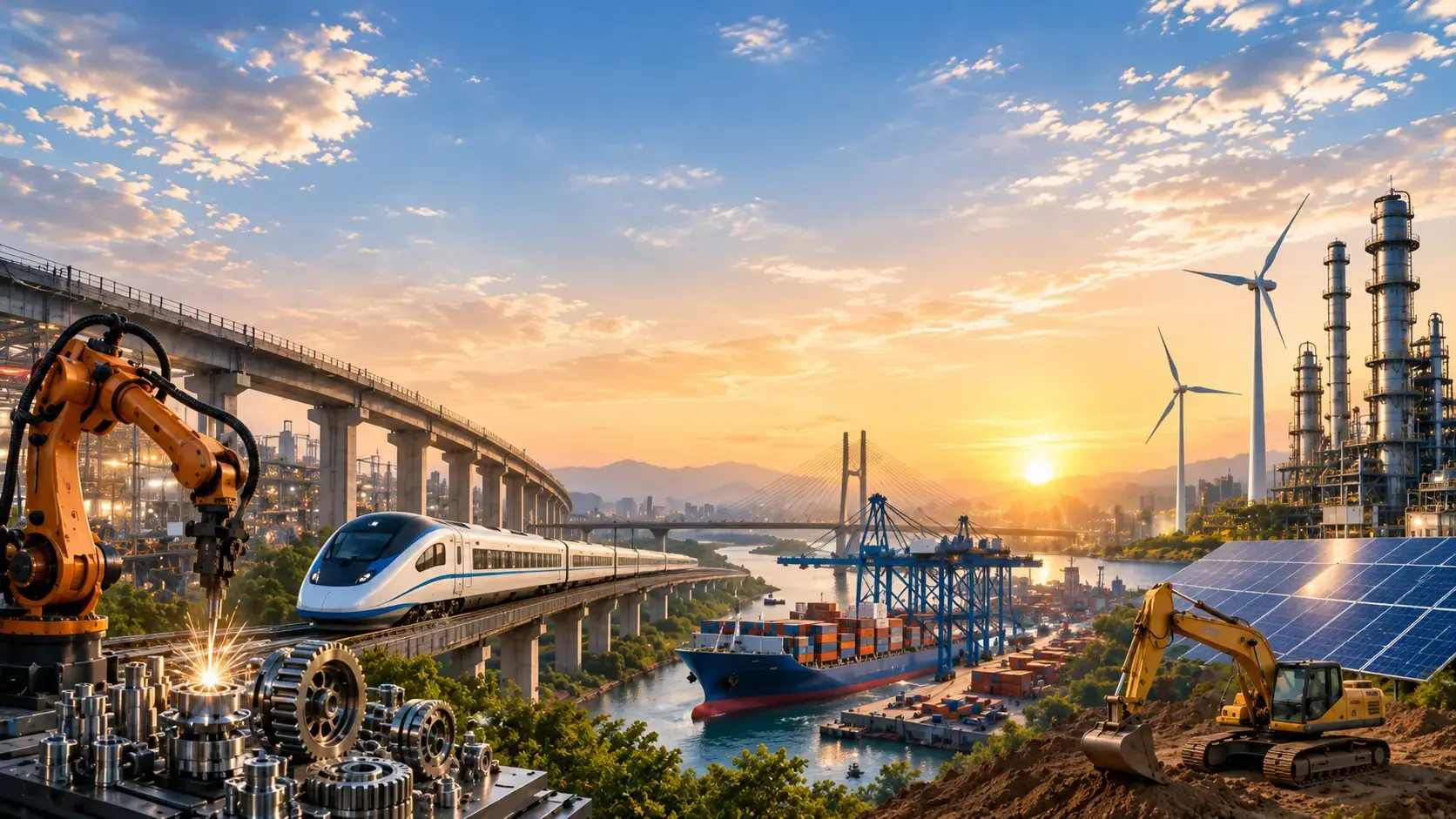
India's capital goods sector is emerging as a critical pillar of industrial growth, supported by infrastructure investment, expanding manufacturing capacity and demand for advanced machinery and equipment. As India strengthens its industrial base, capital goods are enabling businesses to expand production, modernise operations and adopt new technologies.
The sector's momentum is reflected in recent industrial data. India's Index of Industrial Production (IIP) recorded 7.8% growth in December 2025, while the capital goods segment under the use-based classification grew 8.1% year-on-year. Capital goods production increased from ₹1,85,858 crore in FY24 to ₹2,05,194 crore in FY25, while exports rose from ₹31,621 crore to ₹33,356 crore. [1]
This growth reflects a broader investment cycle across infrastructure, manufacturing, energy, transport and technology. Continued public capital expenditure, domestic manufacturing initiatives and technology adoption are creating demand for machinery, industrial equipment and engineering solutions.
Quick Takeaways
- India's capital goods segment recorded 8.1% year-on-year growth in December 2025.[1]
- Public capital expenditure and manufacturing expansion are supporting demand for industrial equipment.
- Government initiatives are supporting technology development, indigenisation and domestic manufacturing.
- Rising capital goods imports also indicate continued demand for technologically advanced machinery.[1]
Understanding Capital Goods in Economics
In capital goods in economics, the term refers to physical assets that businesses use to produce other goods and services rather than for direct consumption.
The importance of capital goods extends across the economy because investment in machinery and equipment enables businesses to expand production. India's recent industrial performance reflects this relationship: the capital goods segment under the IIP use-based classification grew 8.1% year-on-year in December 2025, while manufacturing also grew 8.1% and overall IIP expanded 7.8%. [1]
As industrial activity expands, businesses require new equipment, while investment in machinery further strengthens production capacity. This creates a reinforcing cycle between capital goods investment and industrial growth.
Infrastructure Investment Is Creating Demand for Capital Goods
Infrastructure development remains a major driver of India's capital goods demand. Roads, railways, airports, ports, power infrastructure and urban projects require extensive machinery, engineering equipment and industrial systems.
The Union Budget 2026–27 has proposed public capital expenditure of ₹12.2 lakh crore, reinforcing the government's focus on infrastructure-led development. This investment is expected to support demand for construction equipment, electrical machinery, transport equipment and other industrial capital goods.[2]
Infrastructure investment can also generate demand beyond the initial construction phase. As new transport networks, logistics infrastructure and power projects expand, the wider infrastructure value chain is set to benefit from requirements for construction equipment, engineering solutions, automation and energy-efficient technologies.
Manufacturing Expansion Is Strengthening the Capital Goods Sector
India's manufacturing sector is undergoing structural expansion, increasing demand for machinery, production equipment and advanced industrial technologies.
Manufacturing GVA growth accelerated to 7.72% in Q1 FY26 and 9.13% in Q2 FY26, according to the Economic Survey 2025–26.[3] In December 2025, computer, electronic and optical products grew 34.9%, motor vehicles, trailers and semi-trailers grew 33.5%, and other transport equipment grew 25.1%.[4]
As manufacturing becomes more technology-intensive, businesses increasingly require automated machinery, precision equipment, robotics, digital control systems and energy-efficient production technologies. This creates opportunities for established manufacturers as well as companies bringing advanced technologies and engineering capabilities into India.
Government Initiatives Are Supporting Domestic Manufacturing
India's approach to the capital goods sector extends beyond increasing production.
The National Capital Goods Policy, 2016, established a framework focused on technology development, infrastructure, skills and exports.[5] Subsequently, the Scheme for Enhancement of Competitiveness in the Indian Capital Goods Sector – Phase II has focused on technological capabilities, research and development, smart manufacturing and advanced machinery.
The Union Budget 2025–26 proposed adding 35 additional capital goods for electric vehicle battery manufacturing and 28 for mobile phone battery manufacturing to the list of exempted capital goods. [6]
These measures link capital goods development with wider industrial priorities, including electronics, electric mobility and advanced manufacturing.
Technology Is Reshaping Industrial Capital Goods
Technology adoption is changing demand across India's capital goods industry. Manufacturers are increasingly moving towards automation, digitalisation, connected machinery and smart manufacturing to improve productivity and operational efficiency.
Industry 4.0 technologies can help manufacturers monitor equipment performance, optimise production and reduce downtime, while robotics and automated systems can support precision manufacturing. The 34.9% growth in computer, electronic and optical products in December 2025 also highlights the expanding role of technology-intensive manufacturing.[4]
For the capital goods sector, this transition is creating demand for machinery and industrial solutions that integrate data, automation and advanced controls.
Domestic Production and Export Opportunities
India's capital goods industry is strengthening its domestic production capabilities while expanding its export potential. Capital goods production increased to ₹2,05,194 crore in FY25 from ₹1,85,858 crore in FY24, while exports rose to ₹33,356 crore from ₹31,621 crore.[1]
At the same time, capital goods imports increased by 6.6% in Q1 FY26 and 9.2% in Q2 FY26. The Government notes that these trends reflect sustained domestic investment and continued demand for technologically advanced machinery sourced internationally.[1]
For global businesses, India's expanding industrial base can therefore serve as both a domestic market and a potential manufacturing and export platform.
Why Capital Goods Investment Matters for India's Growth Outlook
Capital goods occupy a strategic position in the investment cycle because they determine how effectively businesses can expand productive capacity. Investment in machinery, equipment and advanced production technologies can support productivity and wider industrial activity.[1]
Recent indicators point towards continued investment momentum. Capital goods imports grew 6.6% in Q1 FY26, 9.2% in Q2 FY26 and 13.4% in Q3 FY26, while capacity utilisation stood at 74.1% in Q1 FY26 and 74.8% in Q2 FY26.[1]
The breadth of this demand spans manufacturing, infrastructure, engineering, technology and emerging industries, giving the capital goods sector a central role in India's next phase of industrial expansion.
The Road Ahead for India's Capital Goods Sector
India's capital goods sector is positioned to benefit from continued infrastructure development, manufacturing expansion and the transition towards advanced production technologies.
Demand for automation, robotics, digital controls and precision equipment is likely to grow as industries modernise. Emerging areas such as electric mobility, electronics, renewable energy and advanced manufacturing can further expand opportunities for specialised capital goods.
For companies exploring investing in capital goods, India offers opportunities across manufacturing, infrastructure, engineering and technology. As the economy expands its productive capacity, the sector will remain an important enabler of India's industrial transformation.
Conclusion
India's capital goods sector sits at the intersection of infrastructure development, manufacturing expansion and technological transformation. Recent growth in production, exports and investment indicators reflects its strengthening role within India's industrial economy.
The combination of public capital expenditure, expanding manufacturing capacity, technology adoption and government support is creating sustained demand for machinery and industrial equipment. As India continues to build a more technologically advanced industrial base, the capital goods sector is positioned to remain a key driver of long-term economic growth and investment.