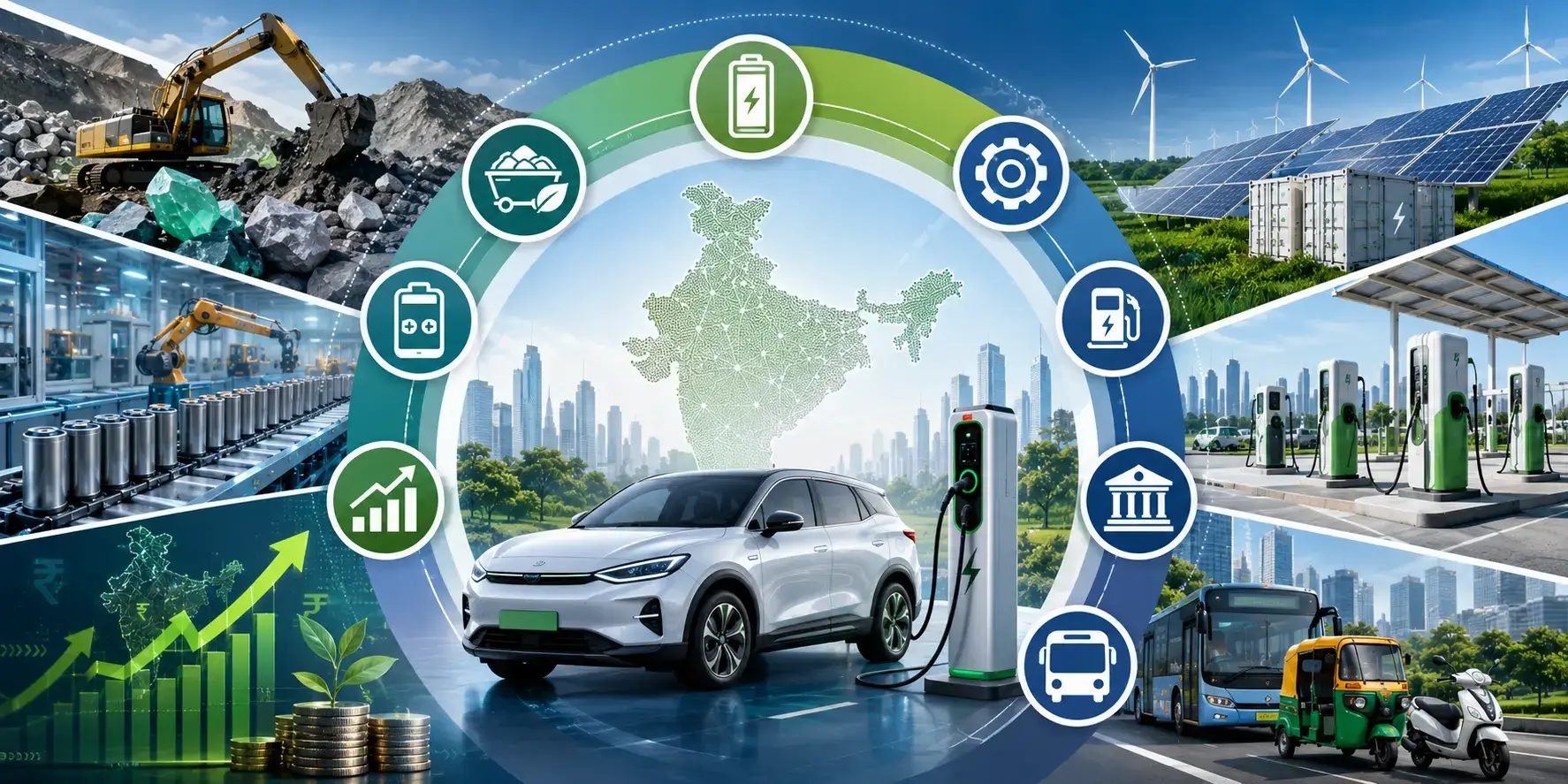
Most public attention on India's electric vehicle market centers on vehicle makers and monthly sales figures. For those looking to invest in electric vehicles, however, a comparable amount of government-backed investment activity sits upstream and downstream of the vehicle itself, in raw materials, cell manufacturing, components, charging infrastructure, and public procurement. Each of these layers carries its own scheme, its own outlay, and in several cases its own implementing agency, distinct from the incentives aimed at vehicle assembly. Electric vehicle investors evaluating entry points, and observers tracking electric vehicle trends more broadly, are increasingly looking at this fuller chain rather than OEM output alone.
Upstream: Critical Minerals and Battery Materials
Before a battery cell is made, it depends on lithium, cobalt, nickel, and related minerals that India largely imports today. The Union Cabinet approved the National Critical Mineral Mission (NCMM) in January 2025[13] with a total outlay of ₹34,300 crore (~USD 3,592 Mn) over seven years, running from 2024-25 to 2030-31,[14] comprising ₹16,300 crore (~USD 1,707 Mn) in government expenditure and an expected ₹18,000 crore (~USD 1,885 Mn) in additional investment from public sector undertakings and other stakeholders.[1] Under the Mission, a separate ₹1,500 crore (~USD 157 Mn) Incentive Scheme for recycling critical minerals from lithium-ion batteries, e-waste, and industrial scrap was notified in October 2025; by April 2026, 58 companies had been found eligible following evaluation of applications received through the scheme window.[2] The Geological Survey of India has also stepped up exploration activity under the Mission, undertaking 195 critical mineral projects in FY 2024-25 and planning 227 for FY 2025-26.[3]
Midstream: Cells, Batteries, and Components
Battery and component manufacturing carry their own dedicated incentive structures, distinct from vehicle assembly:
- PLI Scheme for Advanced Chemistry Cell (ACC) Battery Storage: approved May 2021, outlay of ₹18,100 crore (~USD 1,895 Mn), targeting 50 GWh of cumulative domestic battery manufacturing capacity[4]
- PLI Scheme for Automobile and Auto Component Industry: outlay of ₹25,938 crore (~USD 2,716 Mn), with incentives of up to 18% for electric vehicles and their components[5]
Separately, the broader Automobile Industry sector (as tracked by the Department for Promotion of Industry and Internal Trade, a category that is not EV-specific but includes EV component manufacturing) recorded cumulative FDI equity inflow of ₹2,70,230 crore, approximately USD 40,314 million, between April 2000 and March 2026, ranking 4th among all sectors and accounting for 5% of India's total cumulative FDI equity inflow.[6]
Charging Infrastructure as Its Own Category
Charging infrastructure has developed into a distinct investment line rather than an afterthought to vehicle sales. As of the most recent government data, 67,657 public EV charging stations have been installed across the country, funded through a combination of the FAME-II scheme, under which ₹912.50 crore (~USD 96 Mn) was allocated and ₹633.44 crore (~USD 66 Mn) expended, and the PM E-DRIVE scheme, which carries a separate ₹2,000 crore (~USD 209 Mn) allocation for public EV charging infrastructure, defined to include EV public charging stations, battery swapping stations, and battery charging stations.[7][15] Under PM E-DRIVE, operational guidelines issued in September 2025 govern deployment,[8] with the scheme proposing installation of 22,100 fast chargers for electric four-wheelers, 1,800 for electric buses, and 48,400 for electric two- and three-wheelers.[12] Setting up EV charging stations is classified as an unlicensed activity in India, permitting private sector participation without prior regulatory approval.[7]
State-Level Policies Shaping India's EV Market
State governments are also playing a role in expanding India's electric mobility sector. Several states have introduced policies to encourage EV adoption and attract investment in areas such as vehicle and component manufacturing, battery production, charging infrastructure, and electric public transport. Karnataka, Tamil Nadu, Maharashtra, Telangana and Madhya Pradesh, for example, have introduced policies covering different parts of the EV value chain, with the incentives and areas of support varying across states.[16]
For companies evaluating investment in India's EV sector, these state-level policies can be relevant alongside central government schemes. The incentives available at the state level can include purchase support, road-tax and registration-fee exemptions and other measures aimed at encouraging EV adoption.[17]
Government Procurement as a Demand Driver
Electric vehicle procurement by public agencies is functioning as a distinct channel from retail vehicle sales. Under PM E-DRIVE, ₹4,391 crore (~USD 460 Mn) has been allocated for deployment of 14,028 electric buses, of which 13,800 have been allocated across two phases for seven cities with populations above four million: Bengaluru, Delhi, Mumbai, Hyderabad, Ahmedabad, Pune and Surat.[9] Convergence Energy Services Limited (CESL), the public sector entity conducting demand aggregation for this programme, had already concluded tenders for the 10,900 buses allocated in Phase I, while tenders for the remaining 2,900 buses under Phase II were floated on January 9, 2026.[9] This model, centralized public procurement aggregating demand before manufacturers bid, is structurally different from how private EV purchases are incentivized under the same scheme.
Market Share and Demand Trends
On the demand side, more than 28 lakh electric vehicles had been sold under the PM E-DRIVE scheme as of February 2026, including over 20 lakh electric two-wheelers and nearly 3 lakh electric three-wheelers.[10] As of February 2025, cumulative electric vehicle registrations nationally stood at 56.75 lakh against 3,897.71 lakh total registered vehicles, putting electric vehicles at roughly 1.5% of India's total registered vehicle stock at that point, a national average that understates how much higher electrification has run within the two-wheeler and three-wheeler categories the PM E-DRIVE scheme specifically targets.[11] Demand-side incentives under PM E-DRIVE, worth ₹3,679 crore (~USD 385 Mn, support electric two-wheelers, three-wheelers, ambulances, trucks, and other emerging vehicle categories, distributed through an Aadhaar-authenticated e-voucher system rather than point-of-sale discounting alone.[12]
Outlook
Read together, these threads, mineral security, cell and component manufacturing, charging infrastructure, and public procurement, indicate that capital tied to India's electric vehicle sector is not concentrated in vehicle assembly alone. Each layer carries its own outlay, its own incentive design, and in several cases its own implementing agency, which gives electric vehicle investors more than one point of entry into the sector's continued growth.